Blues History
  • Artists
  • Albums
  • Songs
  • Labels
  1. You are here:  
  2. Home

Home

Slow and Blue: The Recording of "Blue and Lonesome" by Memphis Slim and His House Rockers

Details
Written by: Administrator
Category: Songs
Published: 11 May 2026
Hits: 1
  • Memphis Slim
  • Blue and Lonesome
  • Miracle Records

Introduction: A Song That Became a Title

In the summer of 1949, a 78 rpm record pressed on the small Chicago-based Miracle label began appearing in jukeboxes and record shops across the country. Its A-side carried a slow, melancholy blues in which a big man's big voice confessed to a state of complete desolation — blue and lonesome, he sang, and the music made the claim utterly convincing. The record was credited to Memphis Slim and His House Rockers, and its title — "Blue and Lonesome" — named a feeling that blues had always claimed as its particular territory, but had rarely captured with such directness and emotional authority.

The single climbed to number two on Billboard's Most-Played Juke Box Rhythm & Blues Records chart, where it remained visible for eleven weeks. It was the third of seven R&B hits that Memphis Slim would register before the decade was out, confirmation of a commercial talent that had not fully declared itself before the Miracle years. And it would prove durable enough to give its title to a 2001 Delmark Records compilation of Memphis Slim's most significant recordings — and, in a coincidence of blues history that speaks to the song's deep cultural resonance, to the title of the Rolling Stones' 2016 album of Chicago blues covers, Blue & Lonesome, which the Stones recorded as a tribute to the music they had grown up hearing.

The story of "Blue and Lonesome" is the story of a musician at the peak of his commercial and creative powers, working with a band of extraordinary quality, in a musical moment when the transition from pre-war blues to post-war rhythm and blues was producing some of the most energetically alive popular music in American history. It is the story of the Miracle label that released it, of the musicians who performed it, and of the broader creative arc that took Memphis Slim from the juke joints of West Memphis, Arkansas, to the stages of Carnegie Hall and the nightclubs of Paris.


The Man: John Len Chatman Before Memphis Slim

John Len Chatman was born on September 3, 1915, in Memphis, Tennessee — the city that would give him his professional name and the first crucial chapter of his musical education. His father, Peter Chatman, was a musician who sang, played piano and guitar, and operated juke joints in the Memphis area, providing the young John with an immersive early exposure to the blues that most musicians of his generation had to seek out. The family connection to blues was not merely incidental; Peter Chatman was part of the musical fabric of South Memphis, and his son grew up inside it.

The piano was the natural instrument — Slim started playing at the age of seven, absorbing the barrelhouse and boogie-woogie styles that were the foundational language of Southern blues piano. His principal influence was Roosevelt Sykes, the St. Louis pianist who had been one of the most prolific and commercially successful blues pianists of the late 1920s and early 1930s. Sykes's rolling, powerful style — simultaneously rhythmically assertive and harmonically sophisticated — was an ideal model for a young pianist with a large physical frame and a naturally commanding presence. By the time he was sixteen, Slim was playing the piano at the Midway Café on Beale Street, the main artery of Memphis's African American commercial and entertainment district.

The 1930s were spent in the grinding but musically fertile environment of juke joints, dance halls, and gambling spots in West Memphis, Arkansas, and southeast Missouri — the border territory between Tennessee and the states to its west and north where blues, boogie-woogie, and early rhythm and blues circulated among working-class Black communities. It was music for people who worked hard and played hard, and the demands of that audience shaped Slim's music in ways that would remain audible throughout his career: he learned to entertain as well as to express, to make people dance as well as to move them emotionally, to hold an audience's attention through the long hours of a Saturday night.

He settled in Chicago in 1939. The move placed him at the centre of the most fertile blues and R&B environment in the country — a city where the Great Migration from the South had created enormous African American communities with the money and the appetite for the music they had brought with them, and where the recording industry, in the form of Bluebird, Decca, and the emerging independent labels, was beginning to document that music systematically. He quickly found work with Big Bill Broonzy, filling in on piano for Broonzy after the death of Joshua Altheimer — the pianist who had been Broonzy's most important musical partner in the late 1930s. Broonzy, a sophisticated performer who had worked his way from country blues to the polished urban ensemble sound of his Memphis Five, became a mentor and advised Slim to develop his own style rather than simply continuing to imitate Sykes. The advice took.

His first commercial recordings came in 1940, for OKeh Records under the name Peter Chatman — using his father's name as a tribute — and for Bluebird Records under the name Memphis Slim, a stage name coined by the label's producer Lester Melrose and reflecting both his origins and his physical stature. "Beer Drinking Woman" and "Grinder Man Blues," recorded for Bluebird in 1940 and 1941, were his first hits under the Memphis Slim name, establishing him as a commercial entity and a regular presence in Chicago's recording studio world.

Throughout the early 1940s, Slim served as a session musician for John Lee "Sonny Boy" Williamson, Washboard Sam, and Jazz Gillum, building his repertoire of Chicago contacts while developing the performing style — commanding, entertaining, capable of filling a room with his presence as easily as his sound — that would define his commercial peak. When he finally assembled his own band after the end of World War II, the accumulated experience of five years in Chicago's musical ecosystem paid off immediately.


The House Rockers: Building the Band

The ensemble that Memphis Slim assembled in the immediate post-war period — which he called the House Rockers — was the musical vehicle that would produce "Blue and Lonesome" and the other Miracle Records recordings that defined his commercial peak. Understanding the band requires understanding the musical moment in which it was formed.

By 1945 and 1946, the jump blues style had become one of the dominant commercial forms in African American popular music. Louis Jordan and His Tympany Five were the pre-eminent commercial act in the genre, their recordings a jubilant synthesis of blues, swing, boogie-woogie, and novelty entertainment that dominated the R&B charts throughout the decade. The jump blues format — small ensemble, featuring saxophone as the primary horn voice, driven by a strong rhythm section, with a pianist-vocalist at the front — was commercially proven, and Memphis Slim's natural abilities as a performer made it an ideal vehicle for his particular gifts.

The House Rockers lineup that recorded at the first Miracle session in the fall of 1946 consisted of four musicians: Memphis Slim on piano and vocals; Alex Atkins on alto saxophone; Ernest Cotton on tenor saxophone; and Willie Dixon on string bass. Both Atkins and Cotton had come from Memphis to Chicago, part of the broader migration of Southern musicians that had made Chicago the centre of American blues recording. Dixon — who would become one of the most important figures in Chicago blues history as a songwriter, bassist, and producer, most famously through his work with Chess Records in the 1950s — was at this point a working musician in the Chicago studio world, his bass playing a fixture of the sound of the emerging independent label scene.

Alex Atkins was a capable alto saxophonist who served primarily as a section player in the House Rockers — providing the high-register colour and the ensemble fills that give the Miracle recordings their characteristic sound. His presence alongside Ernest Cotton created the two-horn front line that was central to the House Rockers' sound: the alto and tenor playing in close harmony or in call-and-response patterns that gave the arrangements a fullness that a single saxophone could not have achieved.

Ernest Cotton was, by most assessments, the more distinctive of the two saxophonists. His tenor playing had the kind of deep, breathy tone quality that characterised the best Chicago R&B saxophone of the period — rooted in the tradition of the big-toned Texas tenor but disciplined by the ensemble demands of the House Rockers' arrangements. The Miracle Records discography documentation notes Cotton's thoughtfully lyrical solo work on slow tracks, a quality that made him a particularly effective voice on the melancholy material like "Blue and Lonesome."

Willie Dixon's bass was the rhythmic and harmonic foundation of the first Miracle session, and his contribution to the recording of "Rockin' the House" — the boisterous boogie that opened Slim's Miracle account — was decisive. Dixon was already developing the compositional and arranging skills that would make him indispensable to Chess Records within a decade, and his musical intelligence is audible in the way he anchored the ensemble without dominating it, creating the platform on which Slim's piano and vocals could move freely.

As the Miracle sessions progressed through 1947 and 1948, the bass chair changed. For the session that produced "Blue and Lonesome," the string bass was played by Ernest "Big" Crawford rather than Dixon. Crawford was a Chicago bassist whose "trademark string-snapping could also be heard on more down-home sessions by Sunnyland Slim and Muddy Waters," according to the detailed Miracle Records discography documentation. His slap-bass technique gave the up-tempo Miracle sides an additional percussive energy, while his melodic sense served the slower material well. In 1949, the addition of a drummer to complete the rhythm section gave the House Rockers their final configuration and made the ensemble fully capable of sustaining the kind of extended live performances that the tour circuit demanded.


The Label: Miracle Records and Lee Egalnick

To understand the recording of "Blue and Lonesome" is to understand Miracle Records — the Chicago independent label that was, despite its relatively brief existence, one of the most important R&B labels of the late 1940s. Miracle Records was the creation of Lee Egalnick, a Chicago record man who had the commercial instinct to recognise that the post-war African American record-buying public represented a commercially significant market, and the entrepreneurial boldness to invest in independent production at a moment when the major labels were still largely in control of recording infrastructure.

Egalnick signed Memphis Slim to Miracle in the fall of 1946, bringing him in with the House Rockers for their first session. The timing was propitious: jump blues was commercially dominant, Memphis Slim was a polished and commercially astute performer with strong connections in the Chicago music world, and the four-piece ensemble he brought to the studio was well-rehearsed and capable. The first session produced "Rockin' the House" — the boisterous boogie that would give the band its name and its commercial identity — and several other sides that established the template for the Miracle recordings.

Egalnick's role at the sessions was primarily that of a label owner supervising his product rather than a hands-on creative producer in the manner of Lester Melrose or Chess Records' founders Leonard and Phil Chess. The musical decisions were Slim's: the songs, the arrangements, the key choices, the tempo settings. What Egalnick provided was the commercial infrastructure — the studio booking, the pressing and distribution, the promotional activity — that transformed Memphis Slim's musical vision into commercial product.

The studio in which the Miracle recordings were made was a Chicago facility typical of the independent label world of the late 1940s — modest in size and equipment by comparison with the major label studios in New York and Los Angeles, but perfectly capable of capturing the direct, unadorned sound that was appropriate to the music. The technical approach of the Miracle recordings is that of minimal processing and maximum presence: Slim's piano is recorded with enough immediacy to hear the attack of his left hand clearly, the saxophones occupy the middle ground of the mix, and the bass provides a solid but not overpowering foundation. The recordings have the quality of a live performance captured directly, which is part of their enduring appeal.

Miracle Records achieved its greatest commercial success with Sonny Thompson's "Long Gone" (1948), which reached number one on the R&B charts and sold approximately 200,000 copies — an extraordinary figure for an independent label. The success of "Long Gone" gave the label commercial credibility and financial resources that it then invested in continuing and expanding its roster. Memphis Slim was its second most commercially successful act, his succession of R&B hits through 1948 and 1949 — "Messin' Around" reaching number one in 1948, "Blue and Lonesome" reaching number two in 1949 — demonstrating that the Miracle gamble on jump blues and urban piano blues was paying off.

Early in 1950, Miracle Records succumbed to financial troubles. Its owners regrouped to form the Premium label, and Slim remained on board through that transition until the successor company faltered in the summer of 1951. The Miracle catalogue was subsequently acquired by King Records, which bought the Hy-Tone sides in 1948 and the Miracle masters after the label's failure. This transaction is one reason that the Miracle recordings are sometimes found credited to King in later reissue contexts.


The Sessions: Recording "Blue and Lonesome"

The precise recording date for "Blue and Lonesome" is not documented with the same certainty as some of the earlier Miracle sessions — the label's own session records were not always preserved with the completeness of major label documentation — but the available evidence places it in 1947, as one of Memphis Slim's 1947 recordings for Miracle that was held back and released in 1949. The Rate Your Music entry for the single confirms that it "debuted on The Billboard Best-Selling Retail Rhythm & Blues Records on 16 July 1949, climbing up to #3 whilst remaining on a listing for 11 weeks, during which it peaked marginally higher at #2 on The Billboard Most-Played Juke Box Rhythm & Blues Records."

The recording that emerged from the Miracle session is characteristically direct. "Blue and Lonesome" is a slow blues — a departure from the boisterous boogie-woogie and jump material that had characterised many of the earlier House Rockers recordings. Where "Rockin' the House" had been an announcement of energy and entertainment, "Blue and Lonesome" was an admission of vulnerability, a statement of loss and isolation that drew on the deepest wells of the blues tradition. The contrast between the two modes — the party music and the confessional blues — defined the dual identity of Memphis Slim's repertoire throughout the Miracle years.

The arrangement is spare by the standards of the House Rockers' output. Slim's piano establishes the tempo and the emotional atmosphere from the opening bars — a rolling, slightly hesitant left hand under a more melodically expressive right, the whole approach reminiscent of the barrelhouse tradition that had shaped him in Memphis even as it pointed toward the more sophisticated urban blues piano style he was developing in Chicago. The saxophones — Atkins on alto and Cotton on tenor — contribute mournful, sustained lines that echo and respond to Slim's vocal without ever crowding it. The arrangements give space: the record breathes, allowing the emotional content of the vocal to register without interference.

Slim's vocal on "Blue and Lonesome" is a masterclass in blues understatement. He was, as one critic observed, "a big man with a big voice and an immaculate touch on the piano," but the "immaculate touch" extended to his singing as much as his playing. He did not shout his blues; he stated them. The delivery is direct without being heavy, mournful without being theatrical. The word "blue" gets emphasis without strain; "lonesome" is allowed to hang in the air with a resonance that the spare accompaniment amplifies rather than fills. It is the sound of a man who has moved past the acute stage of his grief into something more settled and more resigned — the feeling that gives slow blues its particular quality of depth, its sense that the emotion it describes has been lived with long enough to become a part of the person's permanent condition.

The specific personnel on the "Blue and Lonesome" session is documented through the consistent lineup of the House Rockers during the 1947 Miracle period: Memphis Slim (vocal, piano); Alex Atkins (alto saxophone); Ernest Cotton (tenor saxophone); and Ernest "Big" Crawford (string bass), with no drummer recorded on the pre-1949 sessions. The absence of drums gives the recording a slightly open, suspended quality that suits the song's emotional content — the rhythm implied rather than driven, the tempo flowing rather than fixed.


The Sound of the Miracle Recordings

The recording environment of the late 1940s Chicago independent label world was characterised by a direct sonic approach that, far from being a limitation, was one of the defining qualities of the music. The small studios in which Miracle and labels like it worked captured sound with an immediacy that the more elaborate major-label studios could not always achieve — a presence and directness that placed the listener in the room rather than at a processed remove from it.

Memphis Slim's piano sound on the Miracle recordings is worth particular attention. He had developed, over the course of his years playing barrelhouse and boogie-woogie in Memphis and Chicago, an approach that was simultaneously powerful and subtle — capable of driving a fast boogie with the rhythmic authority the genre demanded, but equally capable of the kind of gentle, exploratory touch that slow blues required. On "Blue and Lonesome," the piano is the emotional centre of the recording: the left hand's walking bass lines provide the rhythmic grounding while the right hand's melodic figures comment on and extend the vocal lines, creating a conversation between Slim the singer and Slim the instrumentalist that gives the recording its particular intimacy.

The saxophone section — the defining sonic signature of the House Rockers — had by 1947 developed a working rapport that allowed the two horns to function as a unit rather than two individual voices. Alex Atkins and Ernest Cotton had played together long enough to know each other's tendencies, to anticipate each other's movements, to breathe with a collective rhythm that made the ensemble sound like something more than the sum of its parts. On the slow material like "Blue and Lonesome," this ensemble quality expressed itself as a kind of sustained, sorrowful commentary — the horns providing a harmonic and textural dimension that amplified the emotional content of the vocal without competing with it.

Ernest "Big" Crawford's bass is the rhythmic and harmonic foundation of the recording, his string-snapping technique giving the performance a slight rhythmic emphasis that kept the slow tempo from becoming directionless. The bass line on "Blue and Lonesome" is deceptively simple — a walking figure in the key of the song's blues harmony — but its execution has the quality of someone genuinely listening and responding, of music-making as conversation rather than formula.


Commercial Success and its Context

"Blue and Lonesome" reaching number two on the R&B jukebox chart in 1949 was not an isolated commercial event but part of a sustained run of success that made Memphis Slim one of the most commercially significant artists in the independent label R&B world of the late 1940s. "Messin' Around" had reached number one on the R&B charts in 1948 — a recording that combined the jump blues energy of the House Rockers' live performances with the particular appeal of its lyrical content, a gentle blues complaint about a partner's domestic failures that had the kind of universal relatability that drives jukebox play. "Harlem Bound" was another significant recording from the same period. The succession of hits demonstrated that Memphis Slim had found the sweet spot between artistic authenticity and commercial accessibility that sustained careers in the R&B world.

The commercial success of "Blue and Lonesome" reflected the maturation of Slim's artistry in a specific way: it demonstrated that he could succeed with slow blues as well as with the up-tempo boogie and jump material that had characterised his earlier Miracle work. This versatility — the ability to move between the dance floor and the jukebox's more contemplative corner, between the extroversion of "Rockin' the House" and the inwardness of "Blue and Lonesome" — was the foundation of his commercial longevity. An artist who could only do one thing would be limited to that thing's commercial moment; an artist who could do both could sustain a career across the shifting tides of popular taste.

The jukebox was, in this period, the primary medium through which rhythm and blues reached its audience. Radio largely excluded Black music, particularly the slower and more explicitly adult-themed blues that characterised much of Slim's Miracle output. The jukebox operated differently: it was a commercial machine in African American establishments — bars, restaurants, pool halls, dance halls — that played whatever its operators believed would encourage the maximum number of paid plays. A slow blues that connected emotionally with the audience in those establishments would generate play after play through the simple mechanism of resonance: people heard themselves in the song, heard their own situation articulated, and paid to hear it again.

"Blue and Lonesome" reaching number two on the jukebox chart — an even more impressive showing than its number three position on the retail chart — suggests that this resonance was deep and widespread. The slow blues of loss and isolation was speaking to something real in the experience of the post-war African American working class, and Slim's particular way of articulating that feeling — direct, undemonstrative, emotionally authoritative — was exactly what the moment required.


The Legacy of the Miracle Period and the Song's Afterlife

The Miracle Records recordings of 1946-1949 constitute the creative and commercial peak of Memphis Slim's pre-European career. The House Rockers ensemble — in its various configurations across these years, but with the consistent core of Slim, Atkins, Cotton, and a changing bass player — produced a body of work that captured jump blues and urban piano blues at a specific historical moment with unusual completeness and quality.

"Blue and Lonesome" specifically achieved a cultural permanence that went well beyond its initial chart success. It gave its title to the 2001 Delmark Records compilation of Memphis Slim's work — a gathering that demonstrated how the song had become the single most evocative label for his artistry, the phrase that summed up what he did best and most essentially. The compilation drew on recordings from across his career, including material from the Delmark archive and the United label sessions, but the title came from the 1949 Miracle single: the song that had announced, to the jukebox audiences of the American South and Midwest, that here was an artist who could speak with complete authority about the blues condition.

In 2016, the Rolling Stones released their album of Chicago blues covers under the title Blue & Lonesome — a tribute to the tradition that had shaped them and, specifically, to the Memphis Slim song whose title captured the essence of that tradition. The Stones had grown up on exactly the kind of music that Slim and the House Rockers had made at Miracle — the post-war Chicago blues and R&B that had reached them as teenagers in London through imported American records. Their use of the "Blue and Lonesome" title for their blues tribute album was not accidental; it was a recognition that the phrase, and the song from which it came, had become definitional — a shorthand for an entire musical and emotional tradition.

Memphis Slim himself continued recording long after the Miracle period, moving through Premium, Chess, Mercury, and United before finding his most consistently excellent later recording partnership with Vee-Jay Records from 1958 onward. The United Records period (1952-1954) is particularly celebrated for its introduction of Matt "Guitar" Murphy to the House Rockers ensemble — Murphy, who would later achieve fame through the Blues Brothers, brought a new dimension to the band's sound with his "sensational" guitar work. Willie Dixon, who told Living Blues magazine that Murphy was "definitely the best guitar player, the best one I heard anywhere," endorsed that assessment with characteristic bluntness.

But it was the Miracle recordings, and above all "Blue and Lonesome," that established the essential character of Memphis Slim's art: the big voice and the immaculate touch, the emotional directness and the formal discipline, the capacity to make a listener feel the full weight of the blues without making that weight feel merely heavy. When the Rolling Stones chose "Blue & Lonesome" as the title for their tribute to the music they loved, they were acknowledging what everyone who has listened carefully to Memphis Slim and His House Rockers has always known: that this was music that named something real, something that human beings in hard circumstances needed named, and that in the naming provided something close to consolation.


Conclusion: The Name That Stuck

"Blue and Lonesome" is, in the end, a phrase as well as a song — a compression of the blues condition into its most essential terms. The music that Memphis Slim and His House Rockers recorded for Miracle Records in 1947, released as a single in 1949 and reaching number two on the jukebox chart, is an exemplary realisation of what that phrase means musically: slow, unhurried, emotionally direct, performed with the kind of technical mastery that makes the mastery invisible, the music carrying only the feeling.

The musicians who made it — Slim at the piano, Atkins on alto saxophone, Cotton on tenor, Crawford on bass — were a working ensemble at the height of their collective powers, playing in a style that was simultaneously rooted in the pre-war blues tradition and pointing toward the electrified, rhythm-section-driven Chicago sound that would dominate the 1950s. The recording captured them in a specific, unrepeatable moment: a musical configuration that existed only in the late 1940s, in a specific set of studios and on a specific independent label, before the economics of the music industry changed and the personnel dispersed to other contexts and other collaborations.

"Blue and Lonesome" survived the dispersal. It survived the transition from 78 rpm to LP, from LP to CD, from CD to streaming. It survived Lee Egalnick's Miracle Records, which did not. It gave its name to a Delmark compilation in 2001 and to a Rolling Stones album in 2016, demonstrating that its resonance extended far beyond its original commercial moment. And it stands as the definitive statement of Memphis Slim's art in its richest period — the sound of a great musician, in a great band, recording on a modest label in a city that was then the centre of the blues universe, making something that would last.

Selected Discography

Blue & Lonesome


"Blue and Lonesome" was recorded approximately 1947 at a Chicago studio under the supervision of Lee Egalnick for Miracle Records. It was released as Miracle M-136 in 1949, backed with "Help Me Some." Personnel: Memphis Slim (vocal, piano); Alex Atkins (alto saxophone); Ernest Cotton (tenor saxophone); Ernest "Big" Crawford (string bass). It reached number 3 on the Billboard Best-Selling Retail Rhythm & Blues Records chart and number 2 on the Most-Played Juke Box Rhythm & Blues Records chart, remaining on listings for 11 weeks. The song gave its title to the 2001 Delmark Records compilation Blue and Lonesome and to the Rolling Stones' 2016 album Blue & Lonesome.

Mississippi Fred McDowell

Details
Written by: Administrator
Category: Artists
Published: 11 May 2026
Hits: 0
  • Arhoolie Records
  • Mississippi Fred McDowell
  • Rossville TN
  • Alan Lomax
  • You Got To Move

You Got to Move: The Life, Career, Recordings, and Influence of Mississippi Fred McDowell

Introduction: The Man Found on the Porch

On the first day of autumn, 1959, in Como, Mississippi, a farmer named Fred McDowell emerged from the woods near his neighbour Lonnie Young's front porch carrying a guitar in hand. Alan Lomax and his companion Shirley Collins had been there recording the Young brothers' fife and drum ensemble, as well as the raggy old country dance music of their neighbours, the Pratcher brothers. They had no idea what to expect from this slight man in overalls who had been guided toward them by Ed Young, who had just finished his own recording session. They certainly did not expect what happened next. Over the course of four indelible evenings under the pitch-black Mississippi sky, McDowell played them music that Lomax would later describe as placing him in the company of the greatest blues musicians he had ever encountered, using a single word in his journal to summarise what he had heard: "Perfect."

The word was not hyperbole. Mississippi Fred McDowell was, by any serious measure, one of the finest blues guitarists who ever lived — a man whose bottleneck slide technique had been developing since he was a teenager in Tennessee, refined over decades of playing at fish fries and house parties and juke joints across the Mississippi hill country, and preserved in something close to its original form by the simple fact that no talent scout had ever found him before Alan Lomax did. He was fifty-five years old when those tapes were made. He had been farming cotton and playing music for thirty years in Como, unknown to the music industry, untouched by the commercial pressures that had shaped his contemporaries. And what came out of that encounter was music that still sounds, sixty-five years later, like something arriving from a different dimension of human experience — simultaneously ancient and immediate, technically sophisticated and emotionally raw, rooted so deeply in the African American hill country tradition that it seemed to carry the genetic memory of music going back beyond the blues itself.

This is the story of Fred McDowell: the farmer who became a musician, the musician who became a legend, and the legend who declined, firmly and famously, to play rock and roll.


Origins: Rossville, Tennessee, and the Education of a Guitarist

Fred McDowell was born on January 12, 1904, near Rossville, Tennessee — a date established by most sources, though census and Social Security documents suggest the year may have been 1906 or 1907, and McDowell himself was uncertain of his exact birth date. The ambiguity is itself revealing: it situates him in a world where the administrative apparatus of official record-keeping was remote and unreliable, where the fact of a birth was recorded in a family Bible or in communal memory rather than in a government office.

Rossville is in the western part of Tennessee, about twenty miles east of Memphis — close enough to the great city to feel its gravitational pull but sufficiently rural that the sounds McDowell grew up hearing were the sounds of the hill country, the farm, and the church, rather than the sounds of urban blues entertainment. His parents were farmers — both died while Fred was still a child, leaving him orphaned early. His older, married sister took him in, and it was through this family's connections in both Tennessee and Mississippi that he developed the geographic mobility that would characterise his early life. As Tom Pomposello, a musician and frequent recording partner of McDowell's who wrote about him in Frets Magazine, recalled McDowell saying: "When I was a boy, the first blues record I ever heard was Blind Lemon Jefferson singing 'Black Snake Moan.' 'O-oh ain't got no mama, now.' Man, I tell you, I thought that was the prettiest little thing I'd ever heard."

Jefferson's voice, arriving through whatever primitive phonograph brought those first blues records to rural Tennessee, set the trajectory. McDowell began playing guitar around the age of fourteen — teaching himself, watching other players, absorbing whatever he could from anyone who would show him something. His uncle, Gene Shields, was the first slide guitarist he ever saw, fashioning his slides from a dried steak bone — a technique that McDowell himself adopted before eventually settling on the glass bottleneck that became his defining sonic signature. His main formal influences in Rossville were Raymond Payne, a native of Mount Pleasant, Mississippi, who taught McDowell to play in open G or "Spanish" tuning, and the musician Eli Green, a neighbour and friend in Como whom he described as possessing almost magical musical powers. Green's composition "Write Me a Few Lines" became one of McDowell's signature pieces, recorded multiple times across his career and subsequently taken up by Bonnie Raitt.

The account of McDowell learning to play other people's guitars while they played ball or while he sneaked away to practice is characteristically vivid. His description of the guitarist Raymond Payne — "but if you'd walk into the room he'd put the guitar down so you couldn't see what he was doing. Then he'd make some kind of excuse, 'I'm tired now' or 'My fingers hurt'" — prompted McDowell to observe that this kind of secretiveness was self-defeating: "Other musicians might try to lose you when they play with you, to make themselves look better than you, but they don't know how bad it makes them look." McDowell, by universal account, was the opposite: open, generous, willing to show anyone who asked what he was doing and how he was doing it. This generosity would prove consequential when, decades later, he encountered a young Bonnie Raitt and other musicians eager to learn from him.

At around age twenty-one, McDowell moved to Memphis, where the economic opportunities were somewhat greater than in rural Rossville. He took whatever work was available: stacking sacks of yellow corn at the Buck-Eye Feed Mill, building rail cars, stacking logs, working at a dairy. He played music on the streets for tips and at whatever social events would have him. He also, crucially, encountered the great Mississippi blues musicians who passed through Memphis during this period. He met Charley Patton — whom he described as "a loose mule runnin' around through the world" — and saw him perform in a juke joint near Cleveland, Mississippi, along with Sid Hemphill and Eli "Booster" Green. These legendary players had a great influence on McDowell. He watched Patton, absorbed what he could, and then — characteristically — went off on his own to process it: "Even if you'd be showing me, I'd have to go off on my own and get it my way."

In 1928, he moved back to Mississippi to pick cotton. Through the late 1920s and 1930s, he worked wherever work was available, living the seasonal life of an agricultural labourer while continuing to develop his music. One important detail about his development as a guitarist bears emphasis: McDowell did not own his own guitar until 1941, when one was given to him as a gift. For the first three decades of his playing life, he had been learning and practising on borrowed instruments. This biographical detail is not merely anecdotal; it explains why his approach to the guitar was focused entirely on expression rather than display. He had never had the luxury of practising alone for hours with his own instrument, developing the technical apparatus separate from the social context of performance. Every note he played, he played for someone — at a fish fry, at a dance, accompanying his own singing or someone else's. The music was inseparable from its function.

He finally settled in Como, Mississippi, around 1940, where he would live for the rest of his life. Como is in Panola County in the north Mississippi hill country, about forty miles south of Memphis — an area whose particular geography and social structure produced a distinctive musical tradition that was significantly different from the Delta blues to its southwest, though it shared the same fundamental inheritance.


The Hill Country and Its Music: What Made Fred Different

To understand Mississippi Fred McDowell's music is to understand the hill country of north Mississippi — the uplands to the east and northeast of the Delta, where the flat plantation landscape gives way to rolling, wooded terrain. The geography shaped the social structure: where the Delta was dominated by large cotton plantations that created the mass agricultural labour conditions in which the Delta blues developed, the hill country had many small farms, some of them owned by Black families who had been there for generations. This greater degree of economic independence, and the greater degree of social isolation that came with dispersed small-farm settlement, preserved musical traditions in forms that were closer to their African roots.

The most distinctive characteristic of the hill country blues style that McDowell represented is its approach to rhythm and structure. Where the Delta blues typically used the familiar I-IV-V chord progression of the 12-bar blues — a structure that carries the music through a recognisable series of harmonic changes — hill country blues is built on what writers and musicians have described as a "droning, groove-based approach." The music rests on a single chord, or moves between two chords with minimal harmonic contrast, creating a hypnotic, repetitive quality that has often been compared to the music of West Africa. A song like "Shake 'Em On Down" — McDowell's most celebrated piece, the one that earned him the nickname "Shake 'Em" — does not progress harmonically in the way a standard 12-bar blues does. It grooves, hypnotically and relentlessly, on a single rhythmic-harmonic foundation.

This approach — which Alan Lomax, writing in 1991, characterised by saying Fred was "quite the equal of Son House and Muddy Waters but, musically speaking, their granddaddy" — represents a more direct link to African musical traditions than the blues forms that dominated commercial recording in the 1920s and 1930s. The description of it as resembling African rhythms is not merely aesthetic; it reflects a genuine historical continuity that the isolation of the hill country had preserved.

McDowell's slide technique was the vehicle for this music and its most immediately identifiable characteristic. He wore a glass bottleneck — less than an inch wide, fashioned from the neck of a Gordon's gin bottle — on the ring finger of his fretting hand. This was not the conventional little-finger placement used by most slide guitarists; wearing it on the ring finger left the index and middle fingers free to fret notes below the slide, giving McDowell the ability to play simultaneously in and out of the slide position. The result was a vocabulary of sound that combined the singing, vocal quality of the slide with the articulated precision of conventional fretting — a "beautiful touch and resonating voice-like phrasing that allowed the guitar to speak," as the Blues Foundation put it.

His guitar was tuned to open G — the "Spanish" tuning that Raymond Payne had taught him as a teenager — but he used it in ways that went well beyond the simple chord-strumming for which the tuning is most commonly employed. The complex African-like polyrhythm he generated with his right hand while the bottleneck generated melody in his left was not a technique he had learned from anyone; it was something he had developed himself through decades of practice and performance, an approach so personal and so specific that it would prove extremely difficult for subsequent guitarists to imitate accurately.

"In contrast to the overpowering bottleneck style of Elmore James," one commentator observed, "Fred's lyrical guitar would talk softly, shout with anger, then weep or laugh with the intimate nuances of a friend telling a story." This characterisation captures something essential: where Elmore James used the slide as an instrument of overwhelming power and emotional intensity, McDowell used it as an instrument of conversation, of nuance, of a storytelling intimacy that made even his most intense performances feel personal rather than theatrical.


The Discovery: Alan Lomax and the Southern Journey of 1959

The circumstances that led Alan Lomax to Como, Mississippi, in September 1959 were themselves the product of a long history of field recording and musical research. Lomax had been making field recordings across the American South since the 1930s, when he and his father John A. Lomax had recorded for the Library of Congress — work that had produced the first recordings of Muddy Waters and Honeyboy Edwards, among many others. By 1959, armed with a portable stereo reel-to-reel tape recorder supplied by Atlantic Records and accompanied by the British folk singer Shirley Collins, he was making the trip that would become known as the Southern Journey — a comprehensive field-recording expedition through the rural South that captured an extraordinary range of regional musical traditions.

He had not originally planned to visit the Mississippi hill country. But he was guided there by a blind street singer he encountered in Clarksdale, who pointed him toward the musical richness of the uplands northeast of the Delta. And once there, he was steered toward Fred McDowell by Ed Young, a cane fife player who had just recorded for Lomax himself.

McDowell emerged from the woods near his neighbour Lonnie Young's porch on September 21, 1959, guitar in hand. Over the next four evenings — September 21 through 25 — he played for Lomax and Collins in the open air, sometimes joined by neighbours and friends: Miles Pratcher played second guitar, Fanny Davis played comb (with what Lomax's archive describes as "surely the most powerful comb work ever performed"), James Shorty sang, Annie Mae McDowell harmonised with her husband on spirituals. The repertoire was a cross-section of everything McDowell knew: blues, spirituals, traditional folk pieces, his own compositions, adaptations of songs by artists from Big Maceo to Will Batts to Sonny Boy Williamson.

The recordings reveal an artist whose music was, as the Cultural Equity archive notes, "joyful, sad, erotic, and haunting blues." They document blues performed as it existed in its natural social environment — on a porch, in the open air, for a mixed audience of researchers and neighbours — rather than in the artificial context of a recording studio. The "Shake 'Em On Down" that appears in these tapes is the sound of a song performed for the pure joy of performance, not for commercial calculation. The spirituals have the quality of prayer rather than entertainment.

Lomax's one-word journal entry — "Perfect" — was not a casual superlative. It reflected his understanding, as someone who had spent two decades listening to and recording the greatest folk musicians in America, that what he had encountered in Como was something genuinely exceptional. He understood that McDowell represented a tradition that had been passed over by the commercial talent scouts of the 1920s and 1930s — not because it was inferior but because it was more remote, more hidden, more deeply embedded in a community that had never been accessible to the talent-scouting expeditions.

Atlantic Records included several of McDowell's debut tracks on Lomax's acclaimed Southern Folk Heritage Series in late 1960. The albums introduced a new blues artist to the world — one born a full generation before Robert Johnson but never recorded before, whose music had the freshness of something being heard for the first time precisely because it had never been through the commercial grinder. The response among blues enthusiasts and record producers was immediate.


The Arhoolie Years: Chris Strachwitz and the First Albums

Among those who heard McDowell's tracks on the Lomax/Atlantic releases was Chris Strachwitz, the founder of Arhoolie Records and one of the most important figures in the documentation of American roots music. Strachwitz wrote to Lomax asking for McDowell's address. Lomax wrote back giving it. And in the winter of 1964 — on February 13, to be precise — Strachwitz drove to Como and found McDowell getting off a tractor at his farm.

The recordings that resulted from Strachwitz's sessions — held not in a recording studio but at the farm itself, consistent with all of McDowell's early sessions — formed the basis of two essential albums: Mississippi Delta Blues (Arhoolie 1021, 1964) and Mississippi Fred McDowell, Vol. 2 (Arhoolie 1027, 1966). The Blues Foundation has described Mississippi Delta Blues in terms that make the case for its canonical status: "Perfect" was the one word folk music archivist Alan Lomax penned in his journal the night he recorded McDowell. McDowell's bottleneck style of guitar playing exhibited a beautiful touch and resonating voice-like phrasing that allowed the guitar to speak. The album was inducted into the Blues Foundation Hall of Fame, a recognition that confirmed what careful listeners had been saying since its release: this was not a historical document but a living work of art.

Strachwitz's memories of the Como sessions, preserved in an interview with the Arhoolie Foundation, give a vivid picture of how the recordings were made and how McDowell existed in his community at this transitional moment. The guitarist was still farming, still living the life he had always lived, still unknown outside a relatively small circle of blues enthusiasts. But he was beginning to sense that something was changing. Before his first trip to California, he wrote to Strachwitz asking: "Should I bring an electric guitar or a plain one?" The question is both practical and philosophically significant: even at the beginning of his belated public career, McDowell was thinking about how to present himself to different audiences, how to calibrate his music to different contexts without losing what was essential in it.

The Arhoolie recordings — made in the home setting, with McDowell playing his own guitar in the environment in which he had always played — have a directness and naturalness that subsequent studio recordings could not quite replicate. The session was essentially a performance for Strachwitz and whatever neighbours happened to be around, and McDowell played with the relaxed authority of a musician performing for a familiar audience in a familiar place. The Arhoolie albums established him as one of the great rediscovered voices of the folk blues revival — not a museum piece to be approached with reverent historical interest, but a living musician with something genuinely present to offer.

Annie Mae McDowell, Fred's wife, appeared on several of the Arhoolie sessions. Their vocal duets — particularly on spirituals like "Keep Your Lamps Trimmed and Burning" — have the quality of music made between two people who have been making music together for a very long time, the voices interlocking with the natural ease of decades of shared singing. The inclusion of Annie Mae on the recordings was not a commercial decision but a reflection of reality: she was part of his musical life, as she was part of his domestic life, and to record him without her would have been to present an incomplete picture.


Newport, Europe, and the Second Career

The Lomax and Arhoolie recordings were sufficient to earn McDowell a place in the highest-profile venues of the folk blues revival. He performed at the University of Chicago Folk Festival in 1963 — his first major concert appearance — and at the Newport Folk Festival in 1964, the most prestigious showcase of the folk revival world. He headlined the Ash Grove in Los Angeles in 1964, a venue that had become one of the most important stages for blues artists on the West Coast.

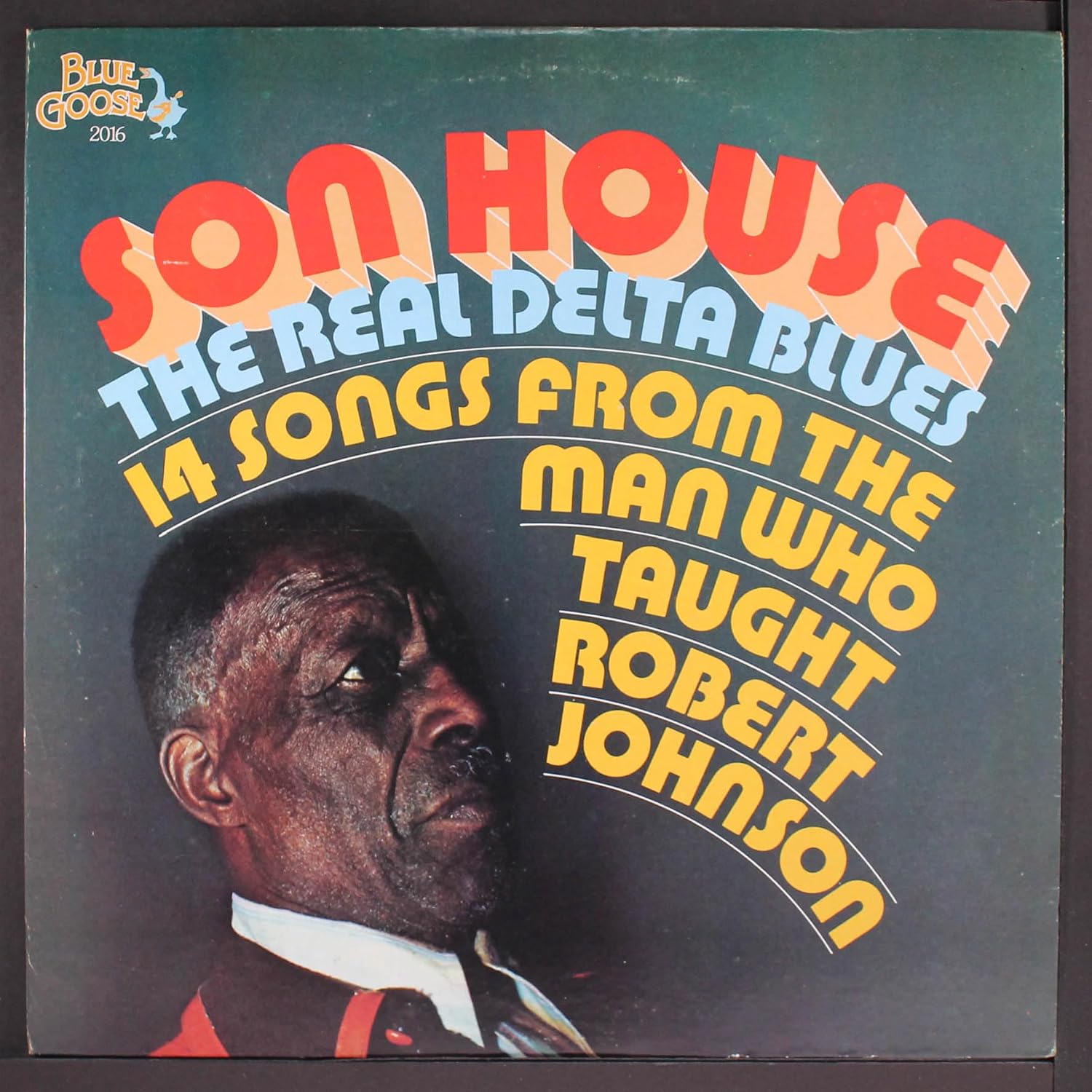
Managed by Dick Waterman — the blues promoter and photographer who also managed Son House, Buddy Guy, and Junior Wells, and who would later preside over McDowell's graveside memorial in 1993 — McDowell navigated the folk blues circuit with characteristic steadiness. He continued to work his day job throughout this period. Even as his reputation grew and bookings became more prestigious, he found himself unable or unwilling to fully abandon the practical work that had sustained him for decades. He kept a job pumping gas at the Stuckey's candy store and service station on I-55 during his final years, even when he was at last able to support himself as a musician. Stuckey's became his social hangout and his office, where he would receive phone calls from booking agents and record producers — a detail that captures perfectly the particular quality of his late-career celebrity: simultaneously famous and entirely unassuming, drawing the world of blues promoters and festival organisers to a gas station in Como, Mississippi.

In 1965, he toured Europe with the American Folk Blues Festival — the package tour that had been bringing American blues artists to European concert halls since 1962. His bandmates on the tour included Big Mama Thornton, John Lee Hooker, Buddy Guy, and Roosevelt Sykes — a lineup that demonstrated both the prestige of the festival and the quality of company in which McDowell was now operating. European audiences, who had been listening to American blues records with an intensity that sometimes exceeded what American audiences brought to the music, received McDowell with the reverence that his music deserved. The British musicians who attended these concerts — young guitarists and blues enthusiasts who would become the architects of the British blues revival — were particularly attentive. Jo Ann Kelly, the British blues singer and guitarist, cited McDowell as a direct influence, as did her brother Dave Kelly, a stalwart of The Blues Band.


The Recordings: A Discographical Survey

The body of recordings McDowell produced between 1959 and 1971 is, for its richness and variety, one of the most significant catalogues in the history of blues documentation. Unlike the pre-war recordings that most of his folk revival contemporaries had made in the 1920s and 1930s — documents of a younger artist captured at a single early moment — McDowell's recordings were made when he was already a fully matured musician, and the consistency of his artistry across twelve years of recorded output is remarkable.

The Lomax Field Recordings (1959) remain the most historically significant and aesthetically pure documents in McDowell's discography. Recorded at Como, Mississippi, on September 21–25 with Lomax's portable stereo tape recorder, they were initially released on Atlantic Records' Southern Folk Heritage Series before being reissued in more comprehensive form by Mississippi Records, Little Axe Records, and Domino Sound in collaboration with the Alan Lomax Archive. They document McDowell in his natural habitat — performing on a porch, in open air, accompanied by friends and neighbours — in a way that no subsequent studio recording could replicate. The repertoire includes "Shake 'Em On Down," "Keep Your Lamps Trimmed and Burning" (with Annie Mae), "61 Highway," "Going Down to the River," and many other pieces that would become signature pieces of his repertoire.

Mississippi Delta Blues (Arhoolie 1021, 1964) was recorded by Chris Strachwitz at McDowell's farm on February 13, 1964. The album's purple cover, designed by Wayne Pope with a prominent colour photograph of McDowell, became one of the most iconic images of the folk blues revival. The repertoire drew on the same core of original compositions and traditional material that the Lomax recordings had documented, but with the slightly more polished quality that came from a musician who had been playing for audiences for several years and had developed a sense of how to pace a recording session. The album was inducted into the Blues Foundation Hall of Fame.

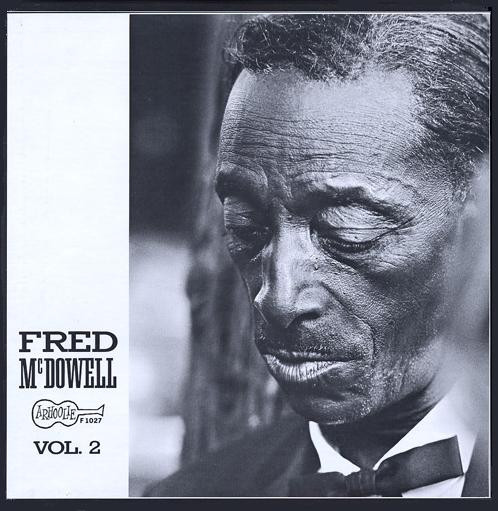
Mississippi Fred McDowell, Vol. 2 (Arhoolie 1027, 1966) presented a second instalment of the Arhoolie recordings, including "You Got to Move" — the gospel-derived song that would become McDowell's most commercially significant composition after the Rolling Stones covered it in 1971. Vol. 2 is, in the assessment of many critics, the equal of the debut and in some respects its superior, benefiting from McDowell's growing ease with the recording format and his expanding sense of how to present his music to audiences beyond Como.

Amazing Grace (Arhoolie 1040, 1966) was a departure: an album of religious music featuring McDowell accompanied by his church group, the Hunter's Chapel Singers of Mississippi, led by Sister Jessie Mae Fortner. The record presented McDowell in the sacred context that had always been as important to him as the blues — the spiritual dimension of his repertoire was not a separate compartment from his blues playing but its complement and counterpart. "You Got to Move" sits at the intersection of these two traditions, as a gospel song performed with the intensity and directness of the blues.

Long Way from Home (Milestone Records, 1966) showed McDowell working in a slightly more produced context, with additional musicians providing rhythm section support. The album sold well and demonstrated that his music could be adapted to a more conventional recording format without losing its essential character.

Levee Camp Blues (Testament, 1968) was produced by Pete Welding, the Testament Records owner who had found his way to McDowell's door in Como in the early 1960s — only eleven days after Strachwitz's first visit, suggesting that word of the Como bluesman was spreading simultaneously through multiple branches of the blues research community. The Testament album presented songs McDowell had performed in his youth — work songs and levee camp blues — that represented a further dimension of his repertoire beyond the dance floor pieces and spirituals of the Arhoolie recordings.

I Do Not Play No Rock 'n' Roll (Capitol Records, 1969) was the album that completed McDowell's commercial transformation, recording at Malaco Studios in Jackson, Mississippi. It was his first featuring electric guitar — a development that had been gradual, beginning with a London recording session in the mid-1960s when he first encountered an electric guitar and was, as he put it, "tickled by the electric slide." The album featured a young white rhythm section and included extended spoken monologues in which McDowell discussed the origins of the blues and the nature of love with the relaxed authority of a man who had been thinking about these subjects for sixty-five years. The title was not, as one commentator observed, necessarily intended to calm the nerves of purists worried about the electric guitar — it was McDowell's own declaration of artistic identity, a statement of what he was and what he wasn't, made with the serene confidence of someone who had never been in doubt about either.

Live at the Mayfair Hotel (1995) and Live in New York (Oblivion Records) documented McDowell's final concert years, capturing performances from 1969 and 1971 respectively. The Mayfair Hotel album, from a concert he gave in 1969 and released posthumously in 1995, was singled out by AllMusic as possibly "the best single CD in McDowell's output, and certainly his best concert release." The Live in New York album, recorded at the Village Gaslight in Greenwich Village in November 1971, shows an artist still at full power in the final months before illness overtook him.


"You Got to Move": The Song That Made Him Famous Twice

Among the specific recordings that McDowell produced across his career, one stands apart in terms of its cultural reach and its commercial consequences: "You Got to Move." The song is a traditional African American spiritual — a gospel piece rooted in the theology of divine sovereignty, declaring that regardless of earthly status (high or low, rich or poor), when God calls, you have no choice but to go. "You may be high, you may be low, you may be rich, child, you may be poor, but when the Lord gets ready, you got to move."

McDowell consistently described it as a church song, not his own composition: "Even as his reputation grew, McDowell continued to describe 'You Got to Move' as 'a church song' and insisted, 'I didn't write it.'" In doing so, he honoured the collective creation of the Black American spiritual tradition, acknowledging the unnamed singers and congregations who shaped it long before it was ever recorded. His own recorded version, made for the second Arhoolie album in 1965, transforms the spiritual into something that sits at the intersection of gospel and blues — the guitar's single-chord drone providing a hypnotic backdrop for vocals that carry the full weight of the song's theological gravity.

The Rolling Stones' recording of "You Got to Move" for Sticky Fingers in 1971 was made at Muscle Shoals Sound Studio in December 1969, with Mick Taylor playing the slide guitar part. The Stones "paid Fred the honour of playing his song straight" — making no attempt to rock it up or adapt it to their usual sound, simply performing it in the spirit in which McDowell had recorded it, with a reverence that spoke to the song's fundamental seriousness. The recording appears on Sticky Fingers alongside songs like "Brown Sugar," "Wild Horses," and "Moonlight Mile" — in that company, the directness and simplicity of "You Got to Move" is startling, a reminder of the depth of the tradition from which the Stones' music ultimately derives.

McDowell was reportedly flattered by the Stones' version. The royalties from Sticky Fingers — one of the best-selling albums in rock history — provided him with the financial windfall that the blues world had never offered him during his decades of performing for local audiences in the Mississippi hill country. As the As the royalties began to come in, he looked set to have a comfortable old age. But cancer had other plans.


Bonnie Raitt and the Teaching Legacy

Among the most consequential personal relationships of McDowell's later career was his connection to Bonnie Raitt, the California singer and guitarist who was building her own career as a blues-influenced rock artist. Raitt had encountered McDowell's music through his recordings and had been profoundly influenced by his slide guitar approach. She sought him out directly, and McDowell — characteristically open and generous with his musical knowledge — coached her in the bottleneck technique that would become one of the defining characteristics of her own style.

McDowell gave Raitt Delta slide guitar lessons, and the effect on her development was lasting and profound. She recorded "Write Me a Few Lines" — one of McDowell's signature pieces, the one learned from his neighbour Eli Green — and "Kokomo" (also known as "Kokomo Blues"), another McDowell standard, incorporating them into her repertoire and acknowledging her debt to him in interviews throughout her career. When McDowell died in July 1972, she was in the middle of recording sessions for her album Give It Up. Her producer Michael had to take Bonnie aside and break the news to her. According to a witness, "she went into the cabin where she was living and stayed inside all day and all the following night. She emerged the next morning and told Michael that she was ready to resume work." Give It Up was dedicated to Mississippi Fred McDowell.

Raitt was among those who eulogised McDowell at the 1993 memorial ceremony presided over by Dick Waterman. The memorial stone — a replacement for the original marker on which McDowell's name had been misspelled — was paid for by Raitt herself. The gesture was characteristic: a great musician paying her personal respects to the man who had taught her, with the concrete practical support that she could now provide and that McDowell had so rarely received during his lifetime.


The Hill Country Legacy: RL Burnside, Junior Kimbrough, and Fat Possum

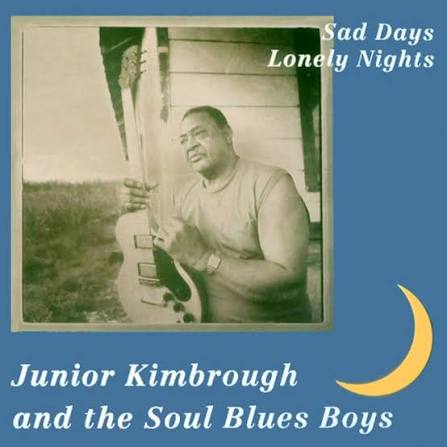
The influence of Mississippi Fred McDowell on subsequent music operates at multiple levels. The most direct is the continuation of the hill country blues style by artists who came after him in the same geographic and cultural tradition. R.L. Burnside started out by playing McDowell's guitar at a house party — a detail that encapsulates perfectly the way musical knowledge transmitted in the hill country, through physical proximity and personal encounter rather than commercial recording or formal instruction. Junior Kimbrough, another Como-area musician whose droning, repetitive blues had the same African rhythmic intensity as McDowell's work, was equally central to the hill country tradition that McDowell had established.

Burnside and Kimbrough, in turn, were the artists whose work provided the impetus for the creation of Fat Possum Records in Oxford, Mississippi, in the 1990s. McDowell's style, or at least its aesthetic, can be heard in the music of such hill country figures as Junior Kimbrough and R.L. Burnside, who in turn served as the impetus behind the creation of the Fat Possum record label. Fat Possum became one of the most commercially successful and critically acclaimed blues labels of the 1990s and 2000s, introducing the hill country blues tradition to alternative rock audiences through a series of recordings that positioned Burnside and Kimbrough in the context of American roots music's avant-garde. The North Mississippi Allstars — Luther and Cody Dickinson, sons of the producer Jim Dickinson — took the hill country aesthetic into rock festival circuits, completing a chain of transmission from McDowell's Como farm to international touring acts.

The broader influence on slide guitar style across multiple genres is harder to quantify but no less real. McDowell's particular approach — the ring-finger bottleneck, the open G tuning, the complex right-hand polyrhythm, the voicing of the slide as speech rather than as decoration — informed guitarists from Bonnie Raitt to the Kelly siblings in Britain to a generation of contemporary blues players who encountered his recordings. His insistence on "feel over flash, to play small and still hit hard," as one commentator put it, represented a philosophically distinct approach to slide guitar from the Elmore James school of overwhelming power — and both traditions have proven enormously generative.

The Louisiana Red — born Iverson Minter in Bessemer, Alabama — named McDowell as an influence and recorded in a similar acoustic hill country style. The Japanese slide guitarist Kiochi Fujishima built much of his approach on McDowell's recordings. The chain of transmission extends, through these and many other individual connections, to a contemporary moment in which McDowell's music is still being actively studied and absorbed by guitarists on multiple continents.


"I Do Not Play No Rock and Roll": The Paradox of the Electric Years

The decision to pick up the electric guitar in the mid-1960s — first in a London recording session, then more consistently from the I Do Not Play No Rock 'n' Roll album onward — was one of the more paradoxical moves of McDowell's career. The man who declared himself emphatically not a rock and roll musician was, by the time of his Capitol album, performing on the same electric guitar that defined rock music's sound, backed by a young white rhythm section that was clearly influenced by rock as much as by blues.

The paradox is more apparent than real. What McDowell meant by "I do not play no rock and roll" was not a rejection of electric instruments but a rejection of a set of musical values that he associated with rock — the subordination of feel to volume, of groove to flash, of the blues tradition's fundamental seriousness to the commercial entertainment values of the pop industry. "My style's the same," he said, explaining the move to electric guitar. "I'm using the electric guitar for the sound it sounds louder, and it plays easier too. But my style's the same." The electric guitar was a tool, not a statement; it could serve the same musical ends as the acoustic, and McDowell's musicianship was sufficient to make sure it did.

The I Do Not Play No Rock 'n' Roll album divided opinion among blues purists who found the electric setting inauthentic. But the musical content was, as McDowell insisted, the same: the hill country grooves, the bottleneck slide, the spoken blues philosophy, all present and intact regardless of whether the guitar was plugged in. The album's commercial success — it was his first on a major label, Capitol Records — introduced his music to an audience that might not have found its way to the Arhoolie records, and this broader reach was, in the final years of his performing life, a legitimate artistic and commercial priority.


The Final Years and Death

By 1971, McDowell was performing at venues as distant in character from the fish fries and juke joints of his youth as Madison Square Garden, major concert halls in Britain and Europe, and folk clubs throughout the American Northeast. He played the Village Gaslight in Greenwich Village in November 1971 — one of his last documented performances. The cancer that would kill him had already been diagnosed; he was, in the accounts of those who saw him perform in his final year, clearly diminished physically but still capable of producing music of genuine force and beauty when his health permitted.

He died at Baptist Hospital in Memphis on July 3, 1972, at the age of sixty-eight. He was buried at Hammond Hill Baptist Church, between Como and Senatobia, Mississippi. He had been a Freemason, associated with Prince Hall Freemasonry throughout his adult life, and he was buried in Masonic regalia. His gravestone originally misspelled his name; the error persisted for years before the Mount Zion Memorial Fund, working with Dick Waterman and with financial support from Bonnie Raitt, placed a proper memorial on his grave in August 1993. The original stone was subsequently donated by McDowell's family to the Delta Blues Museum in Clarksdale, Mississippi — a fitting destination for a document of the man who had done as much as anyone to put the Mississippi blues tradition on the map of world culture.

He was inducted into the Blues Hall of Fame in 1991, posthumously — the institution recognising, nineteen years after his death, what everyone who had heard him play already knew.


The Legacy: What McDowell Left Behind

Mississippi Fred McDowell left behind several distinct legacies, each significant in its own right.

The musical legacy is the most immediate: an approach to slide guitar and to the hill country blues tradition that has been influential on guitarists across genres, from Bonnie Raitt to the North Mississippi Allstars. His recordings — thirty-odd album sides made between 1959 and 1971, plus the Lomax field recordings that preceded them — constitute a body of work of unusual consistency and depth, documenting a musical tradition that had never been commercially recorded before and might have disappeared entirely without his particular combination of talent, longevity, and good fortune in being found by Alan Lomax at precisely the right moment.

The institutional legacy is embodied in the Fat Possum Records axis — the label and the artists it documented, from Burnside to Kimbrough to their students and successors, whose work carries the hill country aesthetic into the present and connects it to audiences who would never have found their way to Arhoolie Records in the 1960s.

The personal legacy lives in Bonnie Raitt's grave memorial, in the dedicated credit she gave him in interviews and album dedications, in the specific slide guitar techniques she learned from him and passed on to a generation of women guitarists who modelled themselves on her approach. It lives in the stories musicians tell about his generosity — his absolute willingness to show other players what he was doing, to demonstrate his technique without the competitive secretiveness that characterised some of his contemporaries. "Other musicians might try to lose you when they play with you," he said, "to make themselves look better than you, but they don't know how bad it makes them look." He never once hid the guitar.

And the cultural legacy is perhaps the most expansive: the Rolling Stones' version of "You Got to Move" introduced a song rooted in the African American spiritual tradition to a global rock audience, and that audience's encounter with the song created a thread that many of them followed back to the original, to Como, Mississippi, to the farmer in overalls who had emerged from the woods onto a neighbour's porch in 1959 with a guitar in hand and a sound that made Alan Lomax reach for his journal and write a single word.

Perfect.

Selected Discography

The Best of Mississippi Fred McDowell

You Gotta Move


Fred McDowell was born January 12, 1904, in Rossville, Tennessee, and died July 3, 1972, in Memphis, Tennessee. He was buried at Hammond Hill Baptist Church, between Como and Senatobia, Mississippi. He was inducted into the Blues Hall of Fame in 1991. Principal recordings: Alan Lomax field recordings, Como, Mississippi, September 21–25, 1959 (Atlantic/Lomax Archive); Mississippi Delta Blues (Arhoolie 1021, 1964); Mississippi Fred McDowell, Vol. 2 (Arhoolie 1027, 1966); Amazing Grace (Arhoolie 1040, 1966); Long Way from Home (Milestone Records, 1966); Levee Camp Blues (Testament, 1968); I Do Not Play No Rock 'n' Roll (Capitol Records, 1969); Live in New York (Oblivion Records). "You Got to Move" was recorded by the Rolling Stones for Sticky Fingers (1971).

The Sage of Tippo in Hackensack: The Recording of "Parchman Farm" by Mose Allison

Details
Written by: Administrator
Category: Songs
Published: 11 May 2026
Hits: 46
  • Prestige Records
  • Bob Weinstock
  • Mose Allison
  • Parchman Farm
  • Tippo MI

The Sage of Tippo in Hackensack: The Recording of "Parchman Farm" by Mose Allison

Introduction: A Song Born Between Two Worlds

In the autumn of 1957, a piano player from Tippo, Mississippi, walked into a living-room recording studio in Hackensack, New Jersey, and made a record that would eventually be covered by John Mayall, Johnny Winter, Blue Cheer, and dozens of others, entering the canon of blues-jazz standards that the 1960s British rock scene would treat as sacred texts. The man was Mose Allison. The living room belonged to Rudy Van Gelder, then still practising optometry by day and recording jazz by night. The session was produced by Bob Weinstock of Prestige Records. And the song that has outlasted almost everything else from those sessions — the one that earned Allison his place in the blues pantheon despite the fact that he never played in a juke joint or on a street corner, that he had a BA in English and philosophy, and that he was, as he described himself with characteristic wry self-awareness, a white boy who stole the blues — was "Parchman Farm."

The recording of "Parchman Farm" sits at the intersection of multiple American traditions: the Delta blues from which Allison grew up thirty miles away, the bebop and modern jazz idiom in which he was operating as a working New York musician, the folk blues revival that was beginning to make artists like Bukka White — who had written the original "Parchman Farm Blues" seventeen years earlier — newly visible to a broader public. Understanding it requires understanding all of these contexts, the institutions and individuals involved in its creation, and the extraordinary circumstances that produced a piece of music capable of striking with equal force across virtually every musical genre that touched it.


The Place: Parchman Farm and Its Blues Legacy

Parchman Farm — officially the Mississippi State Penitentiary — was established in Sunflower County, Mississippi, in 1900, when the state began acquiring parcels of land for a penitentiary and soon accumulated about 16,000 acres. For decades the prison operated essentially as a for-profit cotton plantation: prisoners grew their own food, made their own clothing, raised livestock, and even served as armed guards or "trusty shooters." The harsh working and living conditions made the institution notorious throughout the South, and the particular cruelty of its regime — which disproportionately imprisoned Black men and extracted their forced labour under conditions barely distinguishable from slavery — made it a powerful symbol of racial injustice in the Mississippi Delta.

The prison was also, paradoxically, a site of remarkable musical preservation. Folklorists from the Library of Congress — Alan Lomax, his father John A. Lomax, Herbert Halpert, and later William Ferris — found Parchman to be a rich repository of older musical traditions. Prisoners had little access to radio or records and, to help pace their labors and pass the day, often joined in work songs that had survived from earlier decades. Alan Lomax observed that such songs "revived flagging spirits, restored energy to failing bodies, brought laughter to silent misery." The Lomaxes first visited in 1933 and returned numerous times, recording blues, work songs, spirituals, and personal interviews with inmates. Among their subjects was Bukka White, who had been convicted of a shooting in 1937 and served a sentence there before being released in 1940.

White's 1940 recording of "Parchman Farm Blues" — made just after his release, when the memory of the prison's "terrible" conditions was still fresh — was a haunting, first-person account of life inside: "Oh, listen you men, I don't mean no harm / If you wanna do good, you better stay off ol' Parchman Farm." The song had the elements of Delta blues, including a one-chord modal arrangement and a slide guitar break. It was not, at the time of its recording, a commercial success; White's post-Parchman career was modest, and the song circulated largely among blues enthusiasts and folk revivalists rather than through mainstream channels. But it lodged in the consciousness of those who heard it, including a boy growing up thirty miles from the prison's gates in the small Delta town of Tippo, Mississippi.


The Man: Mose Allison Between Two Traditions

Mose John Allison Jr. was born on November 11, 1927, on his grandfather's farm near the village of Tippo in Tallahatchie County — on an island in Tippo Bayou, which is how the farm got its name: the bayou encircles it. His father, Mose Allison Sr., was an accomplished stride-style piano player who became an early advocate of land rights for African Americans in the racially segregated Delta. His mother, Maxine Collins Allison, was a grammar school teacher who played the ukulele. The early childhood home featured sawdust-covered floors and ragtime music, a combination that places the young Allison firmly in a specific cultural moment: the white Delta farming community of the late 1920s and early 1930s, where the sounds of African American music penetrated every corner of daily life.

Allison's first musical influences were the country blues artists he heard on the jukebox at his father's service station in Tippo. His earliest exposure to blues on record came through Louis Jordan recordings — "Outskirts of Town" and "Pinetop Blues" — and he has credited Jordan as a major influence, alongside Nat King Cole, Louis Armstrong, Fats Waller, and the boogie-woogie pianists Pete Johnson, Albert Ammons, and Meade "Lux" Lewis. The songwriter Percy Mayfield — "the Poet Laureate of the Blues" — was another significant inspiration on his writing. But undergirding all of these specific influences was a more pervasive environment: "Growing up in an area where there are more blacks than whites, you get familiar with black culture at an early age," he said in a telephone interview. "I heard blues singing from the field workers and neighbours sitting on front porches, with their guitars."

He also heard, from the jukebox and from the cultural air of the Delta, the names and reputations of musicians who inhabited the world just beyond his immediate community. Howlin' Wolf, John Lee Hooker, Muddy Waters, Bukka White, and Charley Patton were presences in the cultural landscape of north Mississippi in a way that was simultaneously intimate and remote — they were of the same place, speaking to the same conditions, but their music circulated in contexts that were racially separated from Allison's white Delta world. He absorbed their music while recognising the distance that separated his experience from theirs, and that recognition — the awareness of having been formed by a tradition not his own — would become one of the defining themes of his art.

He took piano lessons at five, picked cotton in the Delta summers, played piano in grammar school and trumpet in high school, and wrote his first song at thirteen. After a year at the University of Mississippi studying chemical engineering — a programme that suited neither his talents nor his inclinations — he joined the U.S. Army in 1946 and played in the 179th Army Ground Forces Band as both pianist and trumpeter. After mustering out, he enrolled at Louisiana State University in Baton Rouge, where he studied English and philosophy, graduating in 1952. The combination of the Delta blues environment of his youth with the literary and intellectual formation of his LSU education would prove the animating tension of his entire career as a songwriter — the blues as raw material, English literature as the critical lens through which it was refined.

His first professional gig was in Lake Charles, Louisiana, in 1950. He returned to finish his degree, played around the South and Southwest, and then made his first attempt at New York in 1951 — an attempt that failed, as he found nothing but out-of-work musicians. He returned South, finished school, and came back to New York with his family in 1956, this time successfully. In New York, jazz saxophonist Al Cohn became an important mentor. He recorded an album with Cohn and Bob Brookmeyer. His association with drummer Frank Isola, whom he met at the Jazz Loft on 34th Street in Manhattan, led to touring and recording with Stan Getz. He played Birdland, the Jazz Gallery, the Half Note, the Village Gate. And in 1957, he landed his own record contract with Prestige Records.


The Producer: Bob Weinstock and Prestige Records

Prestige Records was, in 1957, one of the most important jazz labels in America. Founded by Bob Weinstock in 1949, it operated from New Jersey and pursued what might be described as a systematically informal production philosophy: Weinstock brought musicians into the studio with minimal pre-organisation, allowed them to improvise and create relatively freely, and captured the results. This approach — often contrasted with the more rehearsed, meticulously prepared Blue Note sessions — produced recordings that had the quality of spontaneous creation, warts and all, and a direct emotional immediacy that the more polished Blue Note sound sometimes lacked.

Weinstock's method suited Allison well, because Allison's music — at least in this early period — was not the product of elaborate compositional planning but of a direct, spontaneous encounter between his jazz bebop piano training and his Mississippi blues sensibility. The songs he brought to Prestige were not fully orchestrated productions but essentially trio pieces, built around the simplest possible arrangement: piano, bass, and drums, with Allison's voice as the primary melodic voice. What Weinstock offered was the space and the commercial infrastructure to capture this stripped-down music efficiently and release it to an audience that was receptive to exactly this kind of hybrid blues-jazz.

Weinstock's relationship with Prestige's other great discovery of this period — Miles Davis, John Coltrane, Sonny Rollins — suggests a producer with an excellent ear for talent but a casual, almost indifferent approach to production. As Van Gelder recalled, "When I experimented, I would experiment on Bob Weinstock's projects. Bob didn't think much of sound... So if I got a new microphone and I wanted to try it on a saxophone player, I would never try it on Alfred's [Lion's, of Blue Note] date. Weinstock didn't give a damn, and it worked out great." This slightly paradoxical observation — that Weinstock's relative indifference to production technique created the conditions for Van Gelder's experimentation — helps explain why the Prestige recordings have a rawer, more direct quality than the more carefully engineered Blue Note productions. Weinstock's nonchalance was, in its way, a creative asset.

Prestige signed Allison to do six albums in two years for $250 per album — a fee that was modest even by the standards of the independent jazz label world of the 1950s. The deal reflected both the commercial uncertainty of an artist who didn't fit neatly into any existing category and Weinstock's characteristic commercial caution. But what it produced, across those six albums and two years, was one of the most distinctive and coherent bodies of work in the history of jazz-blues piano singing.


The Engineer: Rudy Van Gelder and His Hackensack Living Room

If Bob Weinstock provided the commercial framework for the "Parchman Farm" recording, and Mose Allison provided the music, then Rudy Van Gelder provided the sound — the specific sonic environment that captured it.

Van Gelder was, in 1957, still operating out of the recording studio he had built in his parents' living room at 25 Prospect Avenue in Hackensack, New Jersey. He was also, simultaneously, a practising optometrist who had been assigned different days of the week to different record labels in order to accommodate everyone: Prestige, Blue Note, Savoy, and others competed for space in his calendar. The sessions for Allison's Local Color album — which included "Parchman Farm" — took place on November 8, 1957, at this Hackensack location, confirmed by the Prestige Records discography.

The Hackensack studio was not, by any conventional measure, an impressive facility. It was a living room in a suburban New Jersey house, with a control room built at one end and the musicians' performing area in the rest of the space. What made it extraordinary was Van Gelder himself: his technical innovation, his knowledge of microphone placement and signal processing, and his instinct for how to make a small jazz ensemble sound present and alive on tape. The dry acoustics of the working space were partly responsible for his inimitable recording aesthetic — the room's lack of natural reverb meant that the instruments came through with a directness and clarity that lent the recordings their characteristic intimacy.

Van Gelder's recording techniques were so closely guarded that microphones were moved when photography of bands was taking place, in order to disguise his means of recording. Rumours circulated that he would swap out the real microphones he used for stand-in "dummies" before photographs were taken at sessions. What this secrecy protected was an approach to miking small jazz ensembles that placed the piano, bass, and drums in a specific spatial relationship on the tape — a relationship that gave each instrument clarity and presence without sacrificing the sense of a group playing together in a room.

For the Allison trio, the three-instrument ensemble was a challenge that Van Gelder had been developing solutions to across multiple sessions with multiple piano trios in the mid-1950s. The piano needed to be recorded in a way that captured both its percussive attack and its sustaining resonance; the bass needed presence without muddiness; the drums needed definition without dominance. On the "Parchman Farm" recording, all three instruments are captured with a directness and balance that makes the performance feel not just heard but experienced.

Bob Weinstock's praise for Van Gelder — "His rates were fair and he didn't waste time. When you arrived at his studio he was prepared. His equipment was always ahead of its time and he was a genius when it came to recording" — was not just a professional endorsement but a recognition that Van Gelder's efficiency and preparedness made the whole Prestige model workable. Weinstock's relatively relaxed approach to session organisation depended on Van Gelder being ready to capture whatever happened, and Van Gelder's readiness made the casual Prestige session philosophy viable.


The Musicians: Addison Farmer, Nick Stabulas, and the Allison Trio

The supporting personnel on the "Parchman Farm" session were two musicians who constituted Mose Allison's working trio through the crucial 1957-1958 period: Addison Farmer on bass and Nick Stabulas on drums. The Prestige Records discography confirms the lineup: "Mose Allison, piano, trumpet, vocal; Addison Farmer, bass; Nick Stabulas, drums. Van Gelder Studio, Hackensack, NJ, November 8, 1957."

Addison Farmer (1928–1963) was the twin brother of the jazz trumpeter Art Farmer and a bassist of considerable distinction. Born in Council Bluffs, Iowa, and raised in Phoenix, Arizona, Addison had followed his brother into the music world, establishing himself as a reliable and musical bass player in the New York jazz scene. He had appeared on numerous Prestige sessions — Art Farmer's "Farmer's Market" from the previous year featured him alongside Art Farmer's trumpet and Hank Mobley's saxophone — and his musical intelligence and technical command made him one of the most sought-after bassists of his era. His early death at thirty-five, from a cerebral haemorrhage, was a significant loss to the jazz world.

On the Allison trio recordings, Farmer's playing has the quiet authority that distinguished him from the showier bassists of the period. He is always in the pocket, always listening, always providing exactly the harmonic and rhythmic support that the music requires without adding anything that wasn't needed. On "Parchman Farm" specifically, his walking bass line creates the underlying momentum that drives the song forward — a simple, steady pulse that grounds the blues feeling without oversimplifying it. He is the undemonstrative backbone of the recording.

Nick Stabulas was a drummer who worked extensively in the Prestige orbit during the late 1950s, appearing on sessions across a remarkably broad range of contexts. His work with Allison had a particular quality of restraint and listening — he was not a drummer who dominated a small-group jazz or blues-jazz context, but one who found the groove and maintained it without calling attention to himself. The Graham Reid review of the recording notes the groove is "swingingly driven by drummer Nick Stabulas and bassist Addison Farner [sic]," an accurate characterisation of the rhythm section's contribution: they swing without overwhelming, drive without pushing.

The trio format was not an accident. By 1957, Allison had formed his own trio with Farmer and Stabulas as his working band, and the rapport between the three musicians was the product of shared performance experience rather than mere studio familiarity. The ease with which they inhabit "Parchman Farm" — the natural way the bass and drums find the groove, the sense of three musicians playing together rather than accompanying each other — reflects this pre-existing working relationship.


The Session: November 8, 1957, Van Gelder Studio, Hackensack

The session of November 8, 1957, produced material that was released across two Prestige albums: Back Country Suite and Local Color. The Prestige discography confirms that both albums drew from the same session date, with the "Parchman Farm" track assigned to Local Color (Prestige PRLP 7121).

The fact that a single session produced material for two different albums is entirely characteristic of the Weinstock/Prestige approach. Musicians were brought into the Hackensack studio and played — sometimes for a full day — producing a substantial quantity of recorded material from which the label then assembled albums. There was no elaborate setup, no extended arranging session, no multiple-day preparation. Allison and his trio arrived, Van Gelder was ready, and they played. The efficiency of the approach was both its commercial necessity and its artistic virtue: the recordings have the quality of performances captured in the moment, not constructions assembled from multiple takes.

Local Color was almost exclusively composed of Allison's own songs — it was, as Amazon's review notes, "comprised almost exclusively of his own songs, including the now-standard 'Parchman Farm.'" This was a significant statement of artistic identity at a point in Allison's career when his reputation was still forming: here was a pianist-vocalist who was also a composer, not merely an interpreter of other people's material. The album presented him as a songwriter of genuine originality — someone whose compositions had a distinctive voice and a distinctive view of the world. "Parchman Farm" was the most immediately striking of these originals, both because of its connection to the pre-war blues tradition and because of its lyrical content.


The Song: Allison's "Parchman Farm" and Its Relationship to Bukka White

Allison's "Parchman Farm" is not a straightforward cover of Bukka White's "Parchman Farm Blues." It is an adaptation — drawing on White's subject matter and some of his imagery but transforming both the musical setting and the lyrical approach into something new. Where White's original was an autobiographical lament — the testimony of a man who had actually served time at the prison, sung in the first person with the specificity of direct experience — Allison's version is a meditation, a reimagining of the prison farm experience through the lens of a Mississippi-born musician who had grown up nearby and absorbed the prison's shadow without ever entering it.

The musical transformation is perhaps even more significant than the lyrical one. White's original was a Delta blues — modal, built on a slide guitar drone, with the guttural, grainy vocal style of the Mississippi country tradition. Allison's version is a jazz-blues: it swings, it has the rhythmic ease of bebop-influenced piano playing, it carries the blues feeling through a medium that is simultaneously more polished and more driven than the acoustic Delta style. The piano's left hand walks a steady bass figure under the right hand's spare melodic commentary, and the trio's collectively maintained groove has a circular, hypnotic quality that connects it to the one-chord modal tradition of hill country blues while presenting it through the vocabulary of modern jazz.

The lyrical content of Allison's version retained the core imagery of forced labour and imprisonment — "gonna put your plantin' in the ground / make you chop and pull," or words to similar effect — while filtering it through Allison's characteristic ironic detachment. He was not singing the prison blues from the inside; he was singing about them from the perspective of someone who had grown up knowing the institution was there, thirty miles away, its shadow falling across the Delta landscape. This outsider perspective gave the song a different quality from White's testimony: more meditative, less visceral, but with its own kind of moral weight.


The Sound: What Made the Recording Work

The specific qualities of the Van Gelder recording that capture the performance — the piano's particular warmth, the bass's rounded presence, the drums' controlled swing — are the product of the technical environment described above. But the deeper reason the recording works is musical.

Allison's piano playing on "Parchman Farm" synthesises two traditions that had never previously been brought into quite this specific configuration. The left hand's walking figures come from the boogie-woogie and blues piano tradition that he had absorbed as a child in Tippo — Pete Johnson, Albert Ammons, the sound of boogie-woogie at the service station jukebox. The right hand's melodic improvisations come from the bebop and cool jazz training he had acquired in New York, informed by the harmonic and rhythmic vocabulary of the modern jazz piano. Neither hand is doing what its tradition alone would dictate; they are in dialogue, each modifying and enriching the other.

The vocal delivery — that slow, laconic drawl, so uninflected that it sounds almost like speech — was also a synthesis. Allison's singing drew explicitly from the cool-school vocal tradition of Nat King Cole and the more understated end of the jazz singing spectrum, but inflected with the slow pacing and grammatical directness of Delta blues speaking patterns. He was singing blues, but he was singing it as someone who had studied English literature, and the tension between the vernacular content and the detached, intellectual delivery was part of what made the performance so striking and so difficult to categorise.

The Graham Reid review describes the performance as "typically swinging, groove-driven," and the description captures something essential: it is a blues performance that swings, that has the rhythmic ease of jazz. The swinging quality was not an imposition of jazz values on blues material but the natural product of a musician for whom the two traditions were not separate compartments but the same continuous musical conversation.


The Album: Local Color and Its Context

"Parchman Farm" appeared on Local Color (Prestige PRLP 7121), released in 1959 — a year after the session. The album's title pointed to Allison's geographic and cultural identity, situating him in the "local color" of the Mississippi Delta from which he had come. The songs included other Allison originals — "Mojo Woman," "Town," "In Salah," "Carnival" — as well as his versions of songs associated with the blues and R&B traditions he was drawing from. The cover art and overall presentation positioned the album as the work of a specific place — Mississippi — as filtered through the sensibility of someone who had absorbed that place's music while also bringing a very different set of intellectual and musical tools to bear on it.

The album sat alongside the other Prestige Allison releases of this period — Back Country Suite, Young Man Mose, Ramblin' with Mose, Creek Bank — as part of what was, in retrospect, an extraordinary creative burst. Prestige had signed him to six albums in two years, and those six albums documented the fully formed Allison aesthetic: the trio format, the original compositions, the hybrid blues-jazz approach, the wry, ironic lyrical intelligence. They were not commercially successful in the mainstream sense; Allison never had hit records. But they created the cult following that would sustain his career for six decades and the catalogue of songs that would be covered by everyone from the Who to Bonnie Raitt to Elvis Costello.


The Legacy: A Song That Crossed Every Divide

"Parchman Farm" became one of the most widely covered songs in the Allison catalogue — which is saying something, given the breadth of artists who recorded his material. The British blues revival of the 1960s was particularly enthusiastic: John Mayall recorded it, treating it as the direct blues standard it was. Johnny Winter's version brought it into the hard rock and Southern rock orbit. Blue Cheer's feedback-drenched heavy metal version — which Graham Reid describes as going "a very long way from how they turned out in the hands of people like Blue Cheer" relative to the original's swinging groove — demonstrated that the song's bones were strong enough to survive even the most extreme stylistic transformation.

The song's connection to an actual prison — an actual instrument of racial terror in the Mississippi Delta — gave it a documentary weight that most blues-jazz compositions lack. It was not just a mood or a feeling but a reference to a specific historical reality, and that specificity gave subsequent interpreters something to connect to beyond the purely musical. When the British blues revivalists of the 1960s recorded it, they were connecting not just to Allison's jazz-blues synthesis but to the specific history of racial injustice that the prison represented — a history that was, in 1960s Britain, simultaneously remote and acutely relevant to a music culture that was wrestling with its relationship to African American tradition.

Allison's own relationship to that history was his most complicated and most productive creative resource. He was, as he acknowledged in "Ever Since I Stole the Blues," a white man from rural Mississippi who had grown up immersed in Black culture and Black music without belonging to either. The blues came to him not through direct experience of the conditions that produced it but through proximity — through the jukebox at the service station, through the field workers on the surrounding farms, through the presence of Parchman Farm itself thirty miles down the road. What he made from that proximity was something genuine but also something always slightly outside the tradition — a blues seen from the adjacent angle of an observer rather than from inside the experience.

"Parchman Farm" captures that position perfectly. It is blues about the blues — about the prison that produced some of the blues' most powerful expressions, about the conditions of African American life in the Delta that the prison represented. It is sung by a white man from thirty miles away who absorbed those conditions without sharing them, in a musical language that synthesises the blues tradition with the jazz idiom that had become his professional home. The result is a song of multiple distances — geographic, racial, musical — that somehow narrows all of those distances in the act of performance, creating something that feels, in Van Gelder's Hackensack living room, like a genuine encounter between the Mississippi Delta and the New Jersey suburb of 1957.

That encounter, captured on tape by Rudy Van Gelder, produced by Bob Weinstock, played by Mose Allison and his trio on November 8, 1957, is what has lasted.

Selected Discography

Parchman Farm


"Parchman Farm" was recorded November 8, 1957, at Van Gelder Studio, 25 Prospect Avenue, Hackensack, New Jersey. Personnel: Mose Allison (vocal, piano); Addison Farmer (bass); Nick Stabulas (drums). Produced by Bob Weinstock. Engineered by Rudy Van Gelder. Released on Local Color (Prestige PRLP 7121, 1959). Written by Mose Allison. The song was inducted into the Blues Foundation Hall of Fame. Mose Allison died on November 15, 2016, at his home in Hilton Head, South Carolina. He was named a Jazz Master by the National Endowment for the Arts in 2013.

Let Them Play: The History, Recordings, Artists, and Owners of Prestige Records

Details
Written by: Administrator
Category: Labels
Published: 11 May 2026
Hits: 1
  • Prestige Records
  • Bob Weinstock
  • Hackensack NJ

Introduction: The Quintessence of an Era

There is a sentence in the account that Tad Richards, author of Listening to Prestige, gives of Bob Weinstock's founding vision that cuts to the essential quality of what Prestige Records became. "Prestige, with its laissez-faire attitude — let them play, let the public hear what they played — is the quintessence of the 1950s jazz era." The description is both accurate and, in retrospect, almost impossible to believe. Here was a record label founded by a nineteen-year-old kid who had been running his own record store as a teenager, whose production philosophy was essentially the absence of a production philosophy, whose relationship with his engineer was one of cheerful mutual exploitation, and whose roster — accumulated not through any systematic master plan but through personal enthusiasm and the happy accident of being present at the right moment — came to include Miles Davis, John Coltrane, Sonny Rollins, Thelonious Monk, the Modern Jazz Quartet, and Eric Dolphy. If Blue Note was the carefully considered architectural achievement of post-war jazz recording, Prestige was the inspired accident. And the accidents, collectively, constitute one of the most significant bodies of recorded music in American history.

From its founding in 1949 to its sale to Fantasy Records in 1971, Prestige Records operated for twenty-two years as one of the most important independent jazz labels in the world. In those two decades it documented the transition from bebop to hard bop, the emergence of cool jazz and its relationship to the hotter styles that surrounded it, the development of soul jazz as a commercially viable post-bop idiom, and the first experimental stirrings of what would become free jazz and the avant-garde. Through its subsidiary labels — Bluesville, Moodsville, Swingville, New Jazz — it extended its documentary reach into blues, easy-listening jazz, and acoustic folk material. And through the genius of its principal engineer, Rudy Van Gelder, it created a sonic signature that was immediately recognisable and permanently associated with the sound of a specific place and time: the living room in Hackensack, New Jersey, and the music that happened there between 1952 and 1959.

This is the story of that label, its founder, its artists, and its legacy.


Bob Weinstock: The Kid Who Started a Label at Nineteen

The Prestige story begins, as the All About Jazz review of The Prestige Records Story puts it, with "founder Bob Weinstock, whose deep love of jazz, entrepreneurial spirit and close kinship with musicians that made Prestige an important and historic source of jazz." Born on October 2, 1928, in New York City, Weinstock was the son of an avid jazz fan, and the musical passion ran deep in both generations. As a teenager he was running his own record store, and had already developed a reputation as a distributor of jazz records to collectors worldwide.

Like several other prominent jazz producers of the 1950s, Weinstock started out as a traditional jazz and Dixieland fan — the New Orleans-derived music that had been the dominant popular form of American jazz before bebop upended everything in the mid-1940s. But by the time he was ready to launch his own label, he had found himself standing at the cutting edge of "modern jazz," the shorthand term for the bebop and cool styles that had emerged from Minton's Playhouse and the jam session culture of New York's 52nd Street. He combed New York jazz clubs night after night and became well known to the musicians. "The affable Weinstock was easily welcomed into the players' circle," as one account puts it. "Some even suggested that if he ever started his own label, they'd want to record for him." For the enterprising Weinstock, that was all it took.

In January 1949, Weinstock created a label called New Jazz, with its first release a recording by the Lennie Tristano quintet — a session that yielded the remarkable Lee Konitz performance "Subconcious-Lee," which received rave notices from DownBeat and Metronome and validated the enterprise immediately. Later that year he formed Prestige Records proper, with its logo representing the surfeit of saxophonists he had been recording and releasing. The label's name captured both the aspiration and the reality: Prestige would attract prestigious musicians, and the prestige would in turn attract more musicians.

With assistance from his father, and much travelling across the United States by bus, Weinstock was able to promote his company and gain airplay and jukebox sales for his releases. One of his early and much-needed financial successes was a release of "Moody's Mood for Love" recorded by King Pleasure, which became a nationwide hit in 1954. In 1953, Charlie Parker recorded for Prestige using the alias "Charlie Chan" to skirt contractual issues — one of the stranger episodes in the label's history, the greatest saxophone improviser of his generation recording under a fictional name to fulfil obligations to a label he was legally barred from working with openly.

The label's early office was located at 446 West 50th Street in New York City, and its initial format was the 78-rpm single and later the 10-inch LP, consistent with the format of the early 1950s. As the industry transitioned to the 12-inch LP in the mid-1950s, Weinstock adapted — and his adaptation of the new format would prove particularly consequential, because the extended playing time of the 12-inch LP was perfectly suited to his production philosophy. As Richards recounts: "Weinstock introduced the new idea to Miles before a session. I said Miles, we're going to stretch out. He said, 'You mean we're just going to play?' I said, 'As long as you want, almost within reason.'" The 12-inch LP's extended playing time was what made the Prestige marathon sessions possible, and the marathon sessions were what made the Prestige catalogue legendary.


The Production Philosophy: Spontaneity as Aesthetic

Weinstock's approach to production was, depending on your perspective, either a principled aesthetic commitment or a practical arrangement imposed by commercial necessity. He would have musicians record on one take, insisting that additional takes were less spontaneous and that recording engineer Rudy Van Gelder did not need extra takes to adjust balance. He reused tapes if he thought another take was needed, which left very few alternative versions of Prestige recordings. Sessions were essentially extended blowing dates — the musicians would arrive, Van Gelder would have the microphones set up, and they would play. The preparation was minimal; the music was, in theory and often in practice, the first time these specific configurations of musicians had played these specific arrangements together.

The contrast with Blue Note's approach was stark and was the subject of much discussion among musicians and critics. Blue Note lavished money on rehearsals and their albums sounded more planned than those that came from Prestige. Alfred Lion, Blue Note's founder, paid musicians for rehearsal time and had a clear sonic vision for each recording; he worked with Van Gelder to achieve a specific sound and would challenge the engineer on specific choices. Weinstock, by contrast, was essentially indifferent to the technical side. As Van Gelder recalled: "When I experimented, I would experiment on Bob Weinstock's projects. Bob didn't think much of sound... So if I got a new microphone and I wanted to try it on a saxophone player, I would never try it on Alfred's date. Weinstock didn't give a damn, and it worked out great." This indifference was, paradoxically, the source of some of the most valuable sonic experimentation of the era.

The philosophical dimension of the Prestige approach was articulated by Richards in terms that deserve quotation in full: "Critics have charged that Bob Weinstock's approach was the result of his being too cheap to pay for rehearsal time. But I don't believe it's the whole story. Weinstock started Prestige when he was nineteen years old — just a kid. Jazz as pure spontaneity is a fantasy. It was Jack Kerouac's fantasy when he set out to write poetry as 'spontaneous bop prosody.' And it was a kid's fantasy when young Bob started his own record label. Few kids get to live out their fantasies, and the world is probably the poorer for it. Bob Weinstock did, and recorded jazz is the richer for it."

There is genuine truth in this reading. The Prestige recordings have a quality of life and immediacy that the more carefully engineered Blue Note productions sometimes sacrifice on the altar of technical perfection. You hear musicians thinking, adjusting, responding to each other in real time. You hear the moments of uncertainty alongside the moments of inspiration. And because the musicians involved were, routinely, among the greatest jazz musicians who ever lived, the moments of inspiration were frequent enough to justify the methodology entirely.


Rudy Van Gelder: The Man Who Shaped the Sound

No account of Prestige Records can proceed without extended attention to Rudy Van Gelder, the engineer whose name appeared on the records — prominently, in the Blue Note tradition that Prestige adopted — and whose work defined the sonic character of the label's most important period. Van Gelder was, in 1952 when Prestige first began using his services, a professional optometrist by day who recorded local musicians in a studio he had built in his parents' living room at 25 Prospect Avenue in Hackensack, New Jersey. He had built a control room adjacent to the living room, which served as the musicians' performing area, and the dry acoustics of the working space were partly responsible for his inimitable recording aesthetic.

The Van Gelder sound — that dry, direct, presence-forward approach to recording small jazz ensembles, with each instrument occupying its own clearly defined space in the mix — was the product of both his technical innovation and the specific acoustic properties of the Hackensack living room. By the mid-1950s, Van Gelder's sound in Hackensack was the go-to for labels such as Blue Note, Prestige, and Savoy, between whom he engineered hundreds of sessions. He assigned different days of the week to different labels: Fridays were Blue Note's, other days went to Prestige and the others.

His relationship with Weinstock was characterised by mutual respect and a degree of mutual exploitation that both parties seem to have found entirely satisfactory. Weinstock praised Van Gelder in terms that captured the essential qualities: "Rudy was very much an asset. His rates were fair and he didn't waste time. When you arrived at his studio he was prepared. His equipment was always ahead of its time and he was a genius when it came to recording." Van Gelder appreciated Weinstock's relaxed approach because it gave him the freedom to experiment: the results of those experiments, successful ones, then informed his more tightly controlled Blue Note work.

Van Gelder's recording techniques were so closely guarded that microphones were moved when photography of bands was taking place, in order to disguise his means of recording. Rumours circulated that he would swap out the real microphones for stand-in dummies before photographs were taken. The secrecy protected an approach to miking jazz ensembles that placed piano, bass, and drums in a specific spatial relationship that gave each instrument clarity and presence without sacrificing the sense of a group playing together in a room.

In July 1959, Van Gelder moved his operations from the Hackensack living room to a new, purpose-built studio in Englewood Cliffs, New Jersey — a Frank Lloyd Wright-inspired chapel-like structure with a 39-foot ceiling and fine acoustics designed by architect David Henken. The new studio continued to serve Prestige and Blue Note through the 1960s and beyond, and recordings made there are identifiable by their slightly different sonic character: more spacious, with a natural reverb from the high ceiling that the Hackensack living room had not provided.


Miles Davis: The Artist Who Almost Got Away

The most commercially and artistically significant chapter in the Prestige story involves a musician who, by the time of his greatest recordings for the label, was already in the process of leaving it. Miles Davis's relationship with Prestige was, from its earliest stages, complicated by contractual obligations, financial difficulties, and the simple fact that the trumpeter's talent and ambition outgrew the label's commercial capacities long before he was legally free to go elsewhere.

In January 1951, Prestige Records owner and producer Bob Weinstock had signed Davis to a one-year contract; Davis would continue to record for the label into 1956. Weinstock gave Davis an advance of $750, but the company's artist contracts were often manipulative with low royalties, paying nothing for rehearsal time. Davis initially benefited from the exposure the Prestige recordings provided, but his drug addiction in the early 1950s complicated both his personal life and his professional relationships.

The transformation came at the 1955 Newport Jazz Festival. Davis's mesmerising performance there caught the ear of Columbia producer George Avakian, who said he would sign the trumpeter if he could put together a steady working band. Davis obliged by recruiting Red Garland on piano, Paul Chambers on bass, and Philly Joe Jones on drums, along with Sonny Rollins on saxophone. When Rollins left in September 1955, John Coltrane came in as a replacement, and one of the greatest and most influential jazz groups of the 1950s was born.

Before signing with Columbia, Davis had to fulfil his contractual obligations to Prestige. After recording Miles: The New Miles Davis Quintet, the group's debut for the label, on November 16, 1955, he went into Van Gelder's Hackensack studio twice more: for two marathon recording sessions, held on May 11 and October 26, 1956, respectively. Davis had decided to record the sessions just like they were playing a club date, spontaneously and with no second takes. The quintet recorded 26 tracks in these two marathon sessions, resulting in four epic LPs: Cookin', Relaxin', Workin', and Steamin'.

Rather than saturate the market, Weinstock staggered the release of Davis's remaining Prestige albums over several years. Cookin' appeared in July 1957, Relaxin' in March 1958, Workin' in December 1959, and Steamin' in 1961 — by which point Davis was several albums into a celebrated Columbia career and the Prestige releases were being received as documents of an earlier, equally great chapter rather than as current product. Each album was critically acclaimed; together they constitute one of the most sustained collections of jazz recording in the history of the medium.

In his autobiography, Davis described "the great music we made at both those sessions" and said that he was "real proud of it" — but that he was glad to have fulfilled his obligations to Prestige and was "ready to move on." His son Erin confirmed that his father was immensely fond of the group: "Miles Davis expressed his enthusiasm for the group in this passage from his autobiography: 'By the beginning of 1956, I was really enjoying playing with this group and enjoying listening to them play as individuals.'"

The Miles Davis Quintet sessions, heard in their "correct" chronological order rather than in the artificial album sequences that Weinstock assembled, constitute what one critic called "like hearing a live concert in the studio" — an extraordinary document of five musicians who were, each individually, among the greatest of their generation, finding a collective voice that would influence jazz performance for the next sixty years.


John Coltrane: The Sideman Who Became a Giant

If Miles Davis was the most commercially significant artist on the Prestige roster, John Coltrane — initially a sideman on Davis's sessions — became, over the course of his Prestige recordings, one of the label's most artistically consequential figures. Coltrane's Prestige work captures the saxophonist at a specific, extraordinary moment: already possessed of formidable technical gifts and already reaching toward the harmonic revolution that would come to full fruition on the Atlantic and Impulse! recordings of the late 1950s and 1960s.

The Prestige discography on Coltrane is vast — he appeared as a sideman on sessions led by Davis, Red Garland, Tadd Dameron, Paul Quinichette, and many others, as well as leading his own sessions. His appearance on the 1956 album Tenor Madness with Sonny Rollins — the only known recording of the two giants together — is one of the holy grails of jazz discography. Soultrane (1958), recorded with Red Garland on piano, Paul Chambers on bass, and Art Taylor on drums, showed Coltrane developing the long, snaking melodic lines that writers would later describe as "sheets of sound." Lush Life (1958), partially recorded in a New York hotel room when the full rhythm section was unavailable, showed a different, more vulnerable dimension of his art.

The Prestige Coltrane recordings are not, in general, the definitive documents of his mature art — those would come on Atlantic and especially Impulse! — but they are invaluable documents of the crucible. Weinstock's sessions caught Coltrane in a state of creative emergence, still working out the harmonic and structural ideas that would define his subsequent career, and the spontaneous, unreharsed quality of the Prestige approach captured this emergence with a rawness and immediacy that more planned recordings might have smoothed over.

Coltrane's Complete Prestige Recordings — a box set released in the Fantasy/Prestige reissue era — constitutes an extraordinary archaeological excavation of a major artist's formative years, and its existence as a documentable, comprehensible body of work is one of the more significant contributions that Weinstock's label made to jazz history.


Sonny Rollins: Saxophone Colossus

Sonny Rollins was, of the three great saxophonists who made seminal recordings for Prestige, perhaps the one whose Prestige work was most fully formed and most directly representative of his mature aesthetic. Where Coltrane was in emergence, Rollins was already — by the time of his greatest Prestige recordings — fully realised, the complete master of an approach that would prove hugely influential and would define the hard bop saxophone idiom.

Saxophone Colossus (PRLP 7079, 1957) is the album by which Rollins's Prestige work is immediately identified and by which it will be remembered. Recorded with Tommy Flanagan on piano, Doug Watkins on bass, and Max Roach on drums, the album contains some of the most celebrated performances in jazz history: "St. Thomas," Rollins's reimagining of a West Indian calypso melody that became one of his signature pieces; "You Don't Know What Love Is," a ballad performance of ravishing intensity; "Blue 7," a blues improvisation that the critic Gunther Schuller famously analysed as representing a new standard of motivic improvisation — the systematic development of a small melodic fragment across an extended improvisation in ways that gave the performance the coherence of composed music while remaining fully spontaneous.

The title of the album was itself a statement: Saxophone Colossus. Not "Sonny Rollins Plays" or "The Rollins Quartet" but a declaration that this was something different from mere competence or even excellence — this was the work of someone who had redefined the relationship between a musician and his instrument. The album is ranked at number 182 on Rolling Stone's list of the 500 Greatest Albums of All Time, the only Prestige album on that list, which gives some sense of both the album's cultural reach and the slightly anomalous position of jazz in rock-oriented critical canons.

Rollins Plus Four (1956), made with Clifford Brown, Richie Powell, George Morrow, and Max Roach, is another essential document — the saxophonist working in the company of musicians whose formal approach to hard bop was somewhat different from his own, and producing music of extraordinary vitality as a result. The combination of Rollins's harmonic adventurousness with the Brown-Roach group's formal precision created a productive creative tension that makes these recordings uniquely alive.


Thelonious Monk: The Difficult Genius

Thelonious Monk's relationship with Prestige was one of the more complex in the label's history, partly because Monk himself was one of the most complex figures in post-war jazz. Monk had been recording since 1947 for Blue Note, where his angular, deliberately awkward piano style and his equally angular compositions had attracted devoted critical attention but negligible commercial response. When Blue Note's Alfred Lion grew frustrated with Monk's commercial failure, Weinstock — consistent with his approach of recording anyone he believed was genuinely important — signed him.

The Prestige Monk recordings are not, as a body of work, as celebrated as the Blue Note sides that preceded them or the Riverside sides that followed, but they contain genuine masterpieces. The album Monk's Moods, compiled from 1952-1954 sessions, documents the pianist in a series of trio and solo settings that demonstrate both the extraordinary originality of his compositional voice and the disconcerting peculiarity of his playing. Where most jazz pianists of the period were moving toward greater fluency and technical smoothness, Monk was doing the opposite — building deliberate hesitations, silences, and rhythmic asymmetries into his playing as expressive choices rather than technical limitations.

Monk's Prestige recordings also document his early collaborations with musicians who would prove important to his subsequent career. His working relationship with the tenor saxophonist Sonny Rollins, documented on several Prestige sides, shows the two musicians finding a common harmonic language out of their superficially different approaches — Rollins's growing fluency and motivic rigor complementing Monk's eccentric rhythmic personality in ways that were entirely mutual.


The Modern Jazz Quartet: Elegance and Architecture

If Monk represented one pole of the Prestige aesthetic — the spontaneous, eccentric, uncomfortable — the Modern Jazz Quartet represented its opposite. The MJQ, which recorded for Prestige from 1952 onward, brought an almost classical discipline and formal elegance to jazz that was quite unlike anything else on the label's roster. Pianist John Lewis, the group's musical director and primary composer, had studied at the Paris Conservatoire and brought a compositional intelligence to the quartet's music that was more indebted to Bach and Baroque counterpoint than to the jam session culture from which most of Prestige's other artists emerged.

The album Django (compiled from 1953-1955 sessions and released in 1956) — named for the Belgian jazz guitarist Django Reinhardt, who had died in 1953 — is the masterpiece of the Prestige MJQ recordings. Lewis's title composition, a meditation on loss and memory, features Milt Jackson's vibraphone as the primary melodic voice in sustained dialogue with Lewis's piano, with Percy Heath on bass and Connie Kay (who had replaced Kenny Clarke on drums in 1955) providing the rhythmic foundation. The album captures the MJQ's particular achievement: jazz of genuine structural complexity, fully notated and rehearsed, that nonetheless maintains the spontaneous feel of improvised music because the individual voices — particularly Jackson's vibraphone, which has the warmth and emotional directness of the blues — are always present as human beings rather than as components of a compositional mechanism.

The MJQ were one of the few ensembles able to overcome Weinstock's no-rehearsal practice. For the 1955 release of Concorde and for the 1956 album Django, the group's commitment to formal preparation was so fundamental to their approach that Weinstock had no choice but to accommodate it. The resulting albums are among the most polished and formally complete of the Prestige catalogue — proof that, even within the label's laissez-faire framework, a sufficiently determined artist could achieve his vision.


The Secondary Stars: Red Garland, Gene Ammons, and the Supporting Roster

The genius of the Prestige catalogue is not confined to the five or six names that appear in every jazz history. The label's roster was remarkably deep, and many of its secondary figures produced recordings of major significance.

Red Garland, the pianist who had played with Davis's quintet and who became one of Prestige's most reliably commercial solo artists, produced a series of trio albums through the late 1950s that combined bebop-derived piano sophistication with a bluesy warmth that made them accessible to audiences beyond the strict jazz cognoscenti. Albums like A Garland of Red (1956), Red Garland's Piano (1957), and All Mornin' Long (1957) demonstrated a pianist of consistent elegance and swing who worked in a style that owed something to Ahmad Jamal's spatial approach — a clear Davis influence — while maintaining a hard bop rhythmic drive that the more cocktail-lounge Jamal never aimed for. Garland frequently used Paul Chambers and Art Taylor from the Davis rhythm section, giving these albums a continuity with the quintet recordings that made them feel like extensions of the same musical world.

Gene Ammons, the tenor saxophonist known as "Jug," produced some of the label's most commercially accessible recordings through the late 1950s and 1960s. Ammons's hits, including tracks like "Canadian Sunset," helped bridge jazz with broader audiences, while the label's roster overall played a pivotal role in popularizing hard bop as a vibrant, blues-rooted evolution of bebop. His combination of technical authority and bluesy directness — he was the son of boogie-woogie pianist Albert Ammons — gave his recordings an accessibility that belied their musical sophistication.

Wardell Gray, another tenor player, died in 1955 at the age of thirty-four, and Prestige released memorial albums — Memorial Volume 1 and Memorial Volume 2 (both 1956) — that collected the best of his work for the label. Gray had been one of the great improvisers of his generation, his fluid, linear style representing one of the most elegant syntheses of bebop and swing approaches in the jazz of the early 1950s.

Stan Getz had made some of his most important early recordings for Prestige before his career moved to other labels. His cool, lyrical tone and his harmonic sophistication made him one of the more successful commercial jazz artists of the 1950s, and his early Prestige work documented him before that commercial success had fully arrived.

Jackie McLean, the alto saxophonist, recorded extensively for both Prestige and its New Jazz subsidiary in the late 1950s, producing albums that documented his development from a Parker-influenced bebop player into one of the most distinctive voices in the emerging avant-garde. His albums on New Jazz — 4, 5 and 6 (1956), Makin' the Changes (1957), Strange Blues (1957) — form a continuous autobiographical document of a musician feeling his way toward a new aesthetic.


The Producers: Ozzie Cadena, Bob Porter, and the Post-Weinstock Years

By the later 1950s, Weinstock ceased supervising recording sessions directly, employing a series of producers — Chris Albertson, Ozzie Cadena, Esmond Edwards, Don Schlitten, and most significantly Bob Porter — to fulfil this function. This handover of production responsibilities was partly practical (Weinstock was managing an increasingly complex operation) and partly philosophical (his belief in spontaneity extended to trusting other people's instincts about how to capture it).

Bob Porter, who arrived at Prestige in the mid-1960s and remained one of the label's key producers through and beyond its Fantasy era, was particularly important in developing the soul jazz direction that sustained Prestige commercially after the golden age of the hard bop recordings. Porter had an instinct for the commercial middle ground between jazz and R&B that made him the ideal producer for artists like Richard "Groove" Holmes, Jack McDuff, and Charles Earland, whose records combined jazz musicianship with the earthy appeal of the organ-driven soul jazz idiom.

Porter's approach was somewhat different from Weinstock's — he was more engaged with the production process, more attentive to commercial potential, less committed to the purely spontaneous aesthetic — but he maintained the essential Prestige spirit of treating musicians as adults and letting them play. His productions for Holmes, McDuff, and Willis Jackson gave Prestige its most reliably commercial product of the 1960s, keeping the label financially viable while the pure jazz market contracted.


The Soul Jazz Phase: Holmes, McDuff, and the B-3 Sound

Prestige's commercial survival through the 1960s depended substantially on the soul jazz movement — the organ-driven synthesis of jazz, blues, and gospel that was simultaneously more accessible and more immediately emotional than the complex harmonics of post-bop jazz. The Hammond B-3 organ was the central instrument of this movement, and several of Prestige's most commercially successful 1960s artists were B-3 players.

Richard "Groove" Holmes was perhaps the most commercially successful of these. Holmes's 1965 recording of Erroll Garner's "Misty" — a performance that turned a ballad standard into a soulful gospel-jazz vehicle — was a hit that briefly crossed over to mainstream pop awareness. It appeared on Prestige's 1965 release and gave the label one of its biggest commercial moments. Holmes was not a virtuoso of the European jazz tradition but an original voice in the specifically American tradition of the Black church, the blues, and the dance hall, and his Prestige recordings captured that voice at its most direct and most effective.

"Brother" Jack McDuff was another B-3 player of major commercial appeal, his recordings for Prestige combining the organ's inherent soulfulness with a guitarist's precision — he had played guitar before switching to organ — that gave his arrangements a rhythmic sharpness not always present in the more relaxed organ jazz of the period. His 1963 release Rock Candy became a touchstone of the soul jazz style.

Charles Earland arrived somewhat later, but his Hammond B-3 work for Prestige in the early 1970s continued and extended the soul jazz tradition that Holmes and McDuff had established. Weinstock himself noted the transition to soul jazz with artists such as Earland, Richard "Groove" Holmes, and Willis Jackson as a conscious commercial adaptation — an acknowledgment that the market for pure hard bop jazz had contracted and that Prestige's survival depended on meeting its audience where it was rather than where it should theoretically have been.


The Subsidiary Labels: Bluesville, Moodsville, Swingville, and New Jazz

Prestige's ambition to document multiple dimensions of American jazz and blues culture expressed itself in the creation of a remarkable network of subsidiary labels in 1960, each designed to capture a specific audience or idiom.

Bluesville was launched in 1959 with the primary purpose of documenting the work of older classic bluesmen who had been passed over by the changing audience. Such artists as Roosevelt Sykes, Lightnin' Hopkins, Rev. Gary Davis, Sonny Terry and Brownie McGhee, and Memphis Slim recorded for the label, accounting for more than a quarter of their overall output. The Bluesville recordings were made in Van Gelder's Englewood Cliffs studio — after the Hackensack living room closed in 1959 — and had a consistent sonic character that placed them firmly in the Prestige family. The label documented the folk blues revival from a label perspective somewhat different from the Folkways or Vanguard approaches, favouring jazz-influenced settings for its older blues artists. By 1966, Bluesville had ceased to issue LPs, but its catalogue represented a significant body of blues documentation — Lightnin' Hopkins's Bluesville recordings alone constitute a major document of one of the most original voices in post-war blues.

Moodsville was designed for the easy-listening jazz market — the cocktail hour audience that wanted jazz in the background rather than in the foreground. Its releases featured artists like Dave Pike, Red Garland, and Taft Jordan in settings designed to evoke atmosphere rather than demand engagement. The label was commercially successful and helped cross-subsidise the less profitable but more important jazz documentations going on under the main Prestige imprint.

Swingville focused on older swing-era musicians who had been somewhat left behind by the bebop revolution. Coleman Hawkins, one of the greatest tenor saxophonists of the swing era, appeared on multiple Swingville albums, his still-formidable technique and harmonic sophistication given settings that acknowledged their stylistic roots without being merely nostalgic. The Swingville catalogue represents one of the more thoughtful acts of historical documentation in the Prestige family, capturing musicians who might otherwise have spent the 1960s largely unrecorded.

New Jazz was used for recordings that were somewhat more experimental or less commercially oriented than the main Prestige label. Jackie McLean's early albums appeared on New Jazz, as did recordings by several avant-garde-adjacent artists who were pushing at the edges of the hard bop aesthetic. The New Jazz imprint gave these recordings a separate identity from the main Prestige catalogue while keeping them within the label's distribution and promotional infrastructure.

Prestige International carried folk and world music material. Among the most remarkable releases on this imprint were early albums by Ravi Shankar, the Indian sitar master whose recordings for Prestige International gave the label a presence in world music that none of its contemporaries had achieved. Shankar's Prestige International recordings — made in the early 1960s, years before his association with the Beatles made him internationally famous — are among the most valuable documents of his early recorded work.


The Sale to Fantasy: 1971 and Beyond

In 1972, Bob Weinstock sold Prestige to Fantasy Records and relocated to Florida, where he became a stock and commodities investor. The sale marked the end of his direct control over the label he had founded twenty-two years earlier at the age of nineteen. He had seen the label through from its founding on 78-rpm singles to the 12-inch LP era, from the first Lennie Tristano session in 1949 to the soul jazz recordings that were keeping it commercially viable in the early 1970s. He had documented, in the process, some of the most significant musical moments of the post-war era.

Fantasy Records, which had been acquired in 1969 by Saul Zaentz and his investor group, launched an aggressive reissue program in the 1970s, repackaging classic Prestige sessions into affordable double-LP "twofers" and other compilations to capitalise on the existing catalogue. These repackagings — "Prestige PRST-24001 Miles Davis," "Prestige PRST-24002 Mose Allison," and dozens of others — made the classic material widely available at a time when the original pressings were becoming scarce and expensive. Fantasy further expanded its jazz holdings by acquiring Riverside Records in 1972 and Milestone Records shortly thereafter, creating a jazz catalogue of extraordinary depth.

The Original Jazz Classics (OJC) series, launched by Fantasy in 1982, became the primary vehicle for making the classic Prestige material available to subsequent generations. The OJC reissues — initially on vinyl, then comprehensively on CD — were produced to high technical standards, often with new liner notes and detailed session information, and made the Miles Davis quintet sessions, the Rollins albums, the Coltrane sides, and hundreds of other recordings accessible to buyers who had been born after the original releases appeared. The OJC catalogue became, in effect, the standard reference library for post-war jazz, with the Prestige recordings forming its largest and most significant single component.

Ralph Kaffel — who became the custodian of the label under Fantasy's ownership and later under Concord Music Group, which acquired Fantasy in 2004 — continued the reissue work and oversaw the development of the Rudy Van Gelder Remaster series, launched under the auspices of Concord in early 2006. The series applied digital remastering technology to the original analogue masters under Van Gelder's personal supervision, creating what Concord described as "a collection of reissues of some of the most iconic albums in the Prestige catalog, carefully remastered from the original analog masters." Van Gelder himself, still alive and still engaged with the music at the age of eighty-two when the series launched, brought to the remastering project the same attention and care that had characterised his original work fifty years earlier.

Weinstock himself died on January 14, 2006, in a hospice in Boca Raton, Florida, due to complications of diabetes. He was seventy-seven years old. The obituaries that appeared were remarkable in their unanimous assessment that here was someone who, through the simple act of following his musical enthusiasms and letting great musicians play, had made an indelible contribution to American cultural history. He had not been a great producer in the technical or conceptual sense that Alfred Lion or John Hammond were great producers. He had been a great enabler — someone who created the conditions in which greatness could happen, and then got out of the way.


Conclusion: What the Spontaneity Preserved

The legacy of Prestige Records operates at several levels simultaneously, as is true of any institution that achieves genuine historical significance. At the most direct level, it is the recordings themselves — those thousands of takes laid down at Van Gelder's in Hackensack and Englewood Cliffs between 1952 and the late 1960s, captured with minimal production intervention and maximum musical freedom. The Miles Davis Quintet's marathon sessions of 1956. Sonny Rollins's Saxophone Colossus. Thelonious Monk's early recordings. Coltrane's years of creative development. The MJQ's formal elegance. Mose Allison's blues-jazz synthesis. Lightnin' Hopkins's Bluesville sides. The complete, capacious, improbable catalogue that a nineteen-year-old kid built by going to jazz clubs and telling musicians he believed in them.

At a broader level, the Prestige legacy is the demonstration that an independent label run on the thinnest of margins, with minimal infrastructure and a production philosophy rooted in adolescent idealism about jazz as pure spontaneity, could produce recordings that would still be listened to, studied, and treasured seventy years later. The Prestige model — sign great artists, let them play, get Van Gelder to capture it — was not sophisticated, but it was right. And the rightness of it produced something that the most carefully engineered and expensively produced recordings have not always managed: music that sounds, still, like it is happening in the moment rather than being assembled from the past.

"Prestige, with its laissez-faire attitude — let them play, let the public hear what they played — is the quintessence of the 1950s jazz era," Richards wrote. He is right. And the quintessence, properly preserved and properly heard, is something magnificent.

Suggested Reading

Listening to Prestige: Chronicling Its Classic Jazz Recordings, 1949–1972 (Excelsior Editions)

WAIL: The Visual Language of Prestige Records

Prestige Records: The Album Cover Collection

Selected Discography

The Very Best of Prestige Records: Prestige 60th Anniversary


Prestige Records was founded by Bob Weinstock as New Jazz Records in January 1949 and renamed Prestige later that year. Its principal office was at 446 West 50th Street, New York City, later moving to Bergenfield, New Jersey. Principal engineer: Rudy Van Gelder (Van Gelder Studio, Hackensack NJ 1952–1959; Van Gelder Studio, Englewood Cliffs NJ 1959 onward). Principal producers: Bob Weinstock (1949–1971); Ozzie Cadena; Esmond Edwards; Bob Porter; Don Schlitten. Subsidiary labels: New Jazz; Bluesville (1959–1966); Moodsville (1960–1965); Swingville (1960–1965); Prestige International (1960–1969); Prestige Folklore; Tru-Sound; Status. The label was sold to Fantasy Records in 1971. Fantasy was acquired by Concord Music Group in 2004. Bob Weinstock died January 14, 2006, in Boca Raton, Florida.

Page 1 of 2

  • 1
  • 2

Main Menu

  • Home

Latest Posts

  • Slow and Blue: The Recording of "Blue and Lonesome" by Memphis Slim and His House Rockers
    Details
    2026-05-11 06:54:22
  • Mississippi Fred McDowell
    Details
    2026-05-11 05:11:26
  • The Sage of Tippo in Hackensack: The Recording of "Parchman Farm" by Mose Allison
    Details
    2026-05-11 05:08:00
  • Let Them Play: The History, Recordings, Artists, and Owners of Prestige Records
    Details
    2026-05-11 05:05:03
  • Pure Delta: The Recording of "Glad Rags" by Johnny Shines
    Details
    2026-05-11 04:57:23
  • King Biscuit Time by Sonny Boy Williamson II
    Details
    2026-05-11 04:51:10

Popular Tags

Arhoolie Records 2 Prestige Records 2 Bob Weinstock 2 Sonny Boy Williamson II 1 King Biscuit Time 1 Trumpet Records 1 Lillian McMurry 1 Elmore James 1

Older Posts

  • King Biscuit Time by Sonny Boy Williamson II
  • Pure Delta: The Recording of "Glad Rags" by Johnny Shines
  • Let Them Play: The History, Recordings, Artists, and Owners of Prestige Records
  • The Sage of Tippo in Hackensack: The Recording of "Parchman Farm" by Mose Allison
  • Mississippi Fred McDowell
  • Slow and Blue: The Recording of "Blue and Lonesome" by Memphis Slim and His House Rockers
  • Search